
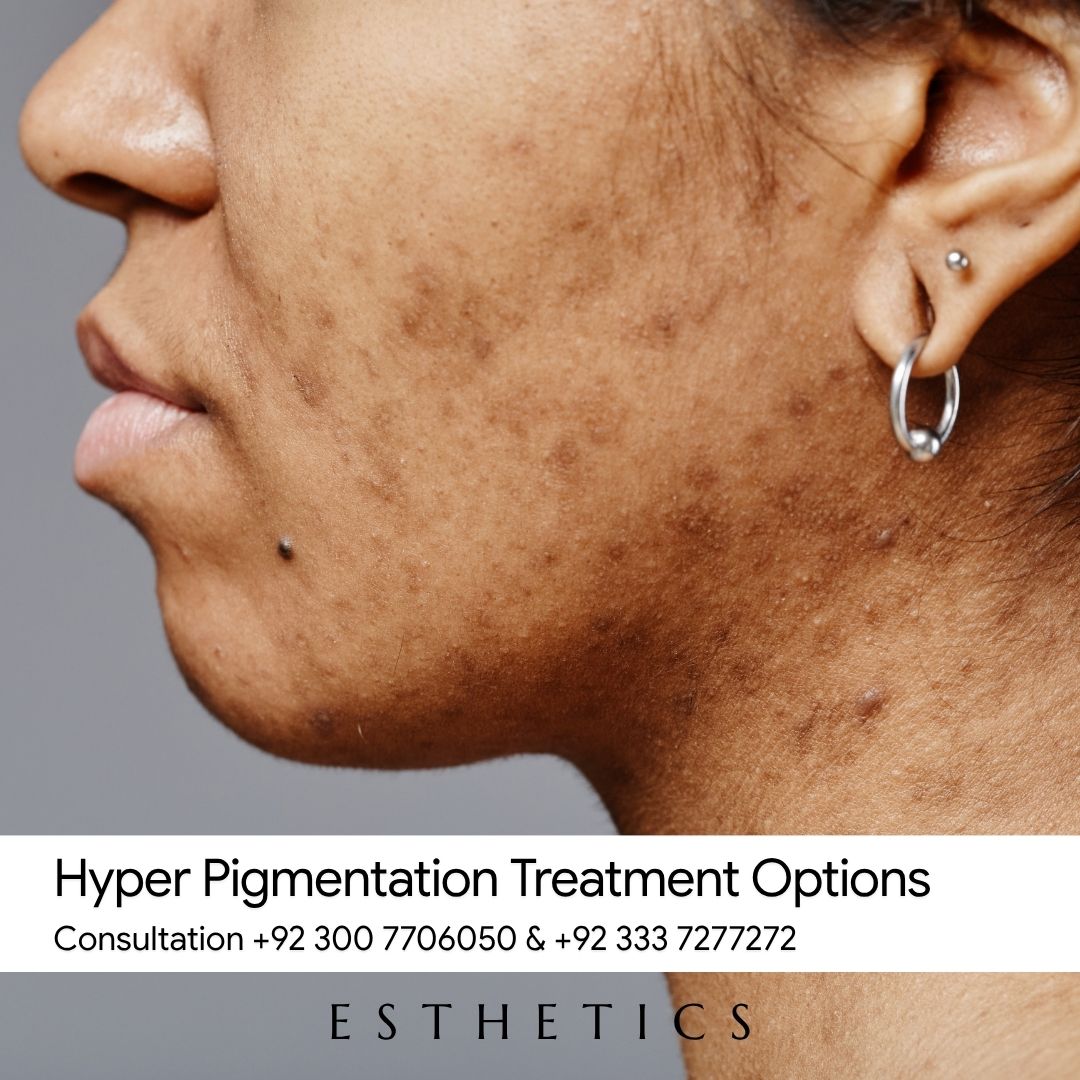
Hyperpigmentation treatment in Pakistan has become an increasingly common dermatology concern for people dealing with dark spots, uneven skin tone, melasma, sun damage, acne marks and pigmentation caused by inflammation or hormonal changes.
Hyperpigmentation can appear on almost any part of the body, but it is particularly noticeable on the face, forehead, cheeks, upper lip, chin, neck and hands. In Pakistan, frequent sun exposure can also make pigmentation more noticeable or difficult to control.
The good news is that there are several treatment approaches available. Depending on the cause and severity, a dermatologist may recommend sun protection, topical medications, chemical peels, microneedling, laser or light-based treatments, or a combination approach. Current dermatology guidance recognizes multiple treatment options for pigmentary disorders, while emphasizing that treatment should be selected according to the specific diagnosis and the patient’s skin type.
One of the most important points to understand is that hyperpigmentation is not one single condition. Melasma, post-inflammatory hyperpigmentation, sunspots and other pigmentary disorders can look similar but may require different treatment strategies.
This comprehensive guide explains the causes of hyperpigmentation, available treatment options in Pakistan, expected results, skincare, laser and peel treatments, prevention and when to consult a dermatologist.
What Is Hyperpigmentation?
Hyperpigmentation occurs when certain areas of the skin become darker than the surrounding skin.
This happens when the skin produces or deposits more pigment than usual.
The pigmentation may appear as:
- Brown spots
- Dark patches
- Uneven skin tone
- Grayish-brown patches
- Dark acne marks
- Sunspots
- Dark areas around the mouth
- Pigmentation on the forehead or cheeks
- Darkened neck
- Post-inflammatory marks
Hyperpigmentation can affect people of all skin types, but pigmentary concerns can be particularly noticeable in people with medium to darker skin tones.
Importantly, hyperpigmentation is a description of a skin finding rather than a single diagnosis.
A dermatologist may need to determine why the pigmentation developed before selecting treatment.
Common Causes of Hyperpigmentation
There are many possible causes of pigmentation.
Some of the most common include:
Sun exposure
UV exposure can stimulate pigmentation and worsen existing dark spots.
Melasma
Melasma commonly appears as darker patches on the face and can be associated with hormonal and environmental factors.
Acne
Inflammation from acne can leave dark marks after the pimple has healed.
Skin irritation
Repeated irritation, rubbing or unsuitable skincare products can contribute to pigmentation.
Hormonal changes
Pregnancy and certain hormonal influences can contribute to melasma.
Skin injuries
Cuts, burns or other inflammation can sometimes leave post-inflammatory pigmentation.
Certain medications or medical conditions
Some medications and medical disorders can contribute to changes in skin pigmentation.
Because causes vary, diagnosis is an important part of hyperpigmentation treatment.
Types of Hyperpigmentation
1. Melasma
Melasma is characterized by brown or gray-brown patches, commonly appearing on the:
- Cheeks
- Forehead
- Nose
- Upper lip
- Chin
It can be influenced by sunlight, hormones and other factors.
The American Academy of Dermatology notes that melasma can have multiple triggers, including sun exposure, pregnancy, stress, medical conditions and certain medications.
Melasma can be persistent and may return even after successful treatment.
2. Post-Inflammatory Hyperpigmentation
Post-inflammatory hyperpigmentation (PIH) occurs after inflammation or injury to the skin.
Common triggers include:
- Acne
- Pimples
- Eczema
- Skin irritation
- Burns
- Picking or squeezing acne
- Certain cosmetic procedures
For example, someone may develop a brown mark after an acne lesion heals.
This is particularly important because repeatedly irritating the skin can create a cycle:
Inflammation → pigmentation → treatment → irritation → more pigmentation
A gentle approach is therefore important.
The AAD notes that picking or squeezing acne can increase the risk of dark spots called post-inflammatory hyperpigmentation.
3. Sunspots
Long-term sun exposure can contribute to localized dark spots.
These may appear on:
- Face
- Hands
- Chest
- Shoulders
- Arms
Sun protection is an important component of preventing additional pigmentation.
4. Acne Marks
Acne does not always end when the pimple disappears.
Inflammation can leave behind dark marks that may remain for weeks or months.
These marks are different from depressed or raised acne scars.
A dermatologist can determine whether the patient has:
- Active acne
- Post-inflammatory pigmentation
- True acne scars
- A combination of these conditions
Treatment should address the underlying acne as well as existing pigmentation.
5. Pigmentation Around the Mouth
Darkness around the mouth can have multiple causes.
Potential contributors include:
- Irritation
- Dryness
- Repeated licking
- Hair removal
- Inflammation
- Hormonal pigmentation
- Melasma
- Post-inflammatory pigmentation
Because the causes differ, applying a strong bleaching product without diagnosis may worsen the problem.
Hyperpigmentation Treatment in Pakistan
The best hyperpigmentation treatment in Pakistan depends on the cause, depth of pigment, skin type and severity.
Treatment options may include:
- Sun protection
- Topical skincare
- Prescription pigmentation treatments
- Chemical peels
- Microneedling
- Laser treatments
- Light-based treatments
- Treatment of underlying acne or inflammation
- Combination treatment
The American Academy of Dermatology’s current educational material on melasma and pigmentation recognizes approaches including photoprotection, topical and oral agents, chemical peels, microneedling, PRP and laser or energy-based treatments.
However, not every treatment is appropriate for every type of pigmentation.
1. Sunscreen for Hyperpigmentation
Sun protection is one of the most important parts of pigmentation management.
Without adequate sun protection, treatment can be less effective and pigmentation can continue to return.
Dermatologists generally recommend a broad-spectrum sunscreen with SPF 30 or higher. The AAD also notes that tinted sunscreen containing iron oxide can provide additional protection against visible light, which can be relevant for people concerned about dark spots.
A good daily routine may include:
- Broad-spectrum SPF 30+
- Adequate application
- Reapplication during prolonged outdoor exposure
- Hat or shade when appropriate
- Avoiding unnecessary intense sun exposure
Why Sunscreen Is So Important
UV radiation can stimulate pigment production.
If someone undergoes a chemical peel, laser treatment or other pigmentation procedure but continues to receive substantial UV exposure without protection, pigmentation may return or become more difficult to control.
Think of pigmentation treatment as a two-part strategy:
Treat existing pigmentation + prevent new pigmentation.
Sunscreen is central to the second part.
The AAD recommends SPF 30 or higher, broad-spectrum, water-resistant sunscreen and advises reapplication every two hours when outdoors, with additional application after swimming or sweating.
2. Topical Treatments for Hyperpigmentation
Topical treatment can be an important part of pigmentation management.
Depending on the diagnosis, a dermatologist may consider ingredients such as:
- Hydroquinone
- Azelaic acid
- Retinoids
- Vitamin C
- Kojic acid
- Other pigment-modulating ingredients
Not every ingredient is appropriate for every patient.
Some prescription treatments should only be used under medical supervision.
The goal is not simply to use the strongest possible cream.
The goal is to find a treatment that provides benefit without causing excessive irritation.
Hydroquinone for Hyperpigmentation
Hydroquinone is a well-known topical pigment-lightening agent that has historically been used for conditions such as melasma and other forms of hyperpigmentation.
However, it should not be treated as an ordinary cosmetic cream.
Appropriate:
- Concentration
- Duration
- Frequency
- Treatment area
should be determined by a qualified clinician when prescription-strength treatment is being considered.
Long-term unsupervised use can cause complications, including a rare condition called exogenous ochronosis.
Patients should therefore avoid buying strong hydroquinone products online and using them indefinitely.
Azelaic Acid for Pigmentation
Azelaic acid is another commonly discussed topical treatment.
It may be useful in selected patients, particularly where pigmentation is associated with acne or inflammation.
One advantage is that it can address both pigmentation and some acne-related concerns.
A dermatologist can determine whether azelaic acid is appropriate for your skin.
Retinoids for Hyperpigmentation
Retinoids can support skin-cell turnover and may be included in treatment plans for selected pigmentation conditions.
They may also be useful when pigmentation is associated with acne.
However, retinoids can cause:
- Dryness
- Irritation
- Peeling
- Increased sensitivity
Overuse can potentially worsen pigmentation in susceptible individuals by causing inflammation.
A gradual, medically appropriate approach is therefore important.
Vitamin C for Dark Spots
Vitamin C is widely used in skincare for uneven skin tone and antioxidant protection.
It may be included as part of a broader pigmentation routine.
However, results depend on:
- Formulation
- Concentration
- Stability
- Consistency
- Skin type
- Underlying pigmentation
Vitamin C should generally be considered a supportive skincare ingredient rather than a guaranteed cure for severe pigmentation.
Kojic Acid for Hyperpigmentation
Kojic acid is another ingredient used in pigmentation-focused skincare.
It can be found in some:
- Serums
- Creams
- Cleansers
- Combination products
However, some people may experience irritation.
A dermatologist can help determine whether it is appropriate for the patient’s skin and whether it should be combined with other treatments.
3. Chemical Peels for Hyperpigmentation
Chemical peels are among the aesthetic treatments that may be used for selected pigmentation problems.
A chemical peel applies a controlled chemical solution to the skin to produce a planned exfoliating effect.
Depending on the type and concentration, chemical peels may help improve:
- Uneven skin tone
- Superficial pigmentation
- Certain acne marks
- Skin texture
The AAD recognizes chemical peels among treatment approaches used for certain pigmentary conditions, including melasma.
However, stronger does not necessarily mean better.
Chemical Peels for Melasma
Melasma can be challenging because the condition may recur.
Chemical peels may be considered as part of a comprehensive plan that also includes:
- Sun protection
- Topical therapy
- Trigger management
- Appropriate maintenance
A dermatologist should determine whether a peel is suitable.
Aggressive peeling in darker skin can sometimes trigger inflammation and post-inflammatory hyperpigmentation.
This is why professional treatment is particularly important.
4. Microneedling for Hyperpigmentation
Microneedling uses very small needles to create controlled micro-injuries in the skin.
It is commonly used for:
- Acne scars
- Texture
- Fine lines
- Selected pigmentation concerns
The AAD notes that microneedling can help fade scars and uneven skin tone in appropriate patients.
For pigmentation, microneedling may sometimes be used alongside topical treatments or other procedures.
However, treatment should be customized to avoid excessive inflammation.
5. Laser Treatment for Hyperpigmentation
Laser treatment can be considered for selected pigmentary disorders.
Different lasers target different chromophores and operate at different wavelengths.
Depending on the diagnosis, a dermatologist may consider laser or light-based treatment for:
- Certain sunspots
- Selected pigmentation
- Some vascular-pigmentary conditions
- Specific pigmentary lesions
The American Academy of Dermatology’s 2026 educational program on melasma includes laser and energy-based devices among current treatment approaches while emphasizing risk-benefit considerations.
Is Laser Safe for Hyperpigmentation?
Laser treatment can be useful, but it is not automatically the best option for every patient.
In darker skin types, inappropriate laser settings can increase the risk of:
- Burns
- Irritation
- Post-inflammatory hyperpigmentation
- Hypopigmentation
- Prolonged redness
Therefore, diagnosis and appropriate device selection are essential.
A pigmentation specialist should determine whether laser treatment is suitable before proceeding.
6. Laser Treatment for Melasma
Melasma deserves special attention because it is often chronic and recurrent.
Laser treatment may sometimes be considered, but it is not necessarily the first or only treatment.
A comprehensive melasma plan may involve:
Sun protection + topical treatment + selected procedures + maintenance
The AAD’s current educational material describes photoprotection, topical agents, oral therapies, chemical peels, microneedling and lasers among approaches considered for melasma.
The choice depends on the patient.
7. Pigmentation Treatment With Combination Therapy
Some patients respond better to a combination approach than to a single treatment.
For example, a dermatologist may combine:
- Sunscreen
- Topical medication
- Chemical peel
- Microneedling
- Laser treatment
However, combination therapy should not mean performing every available treatment.
The dermatologist should select the smallest appropriate combination based on the diagnosis.
Hyperpigmentation Treatment for Darker Skin
Skin of color requires particularly careful pigmentation management.
Patients with medium-to-dark skin can be more prone to post-inflammatory pigmentation after:
- Acne
- Burns
- Irritation
- Aggressive peels
- Certain laser treatments
- Picking
- Inflammation
This means that treatment should focus not only on removing existing pigment but also on avoiding unnecessary inflammation.
The AAD specifically highlights skin-of-color considerations in its dermatology education on pigmentary diseases.
Hyperpigmentation Treatment for Acne Marks
If acne is still active, treating only the pigmentation may not solve the problem.
A more effective approach may involve:
Control acne → reduce inflammation → prevent new marks → treat existing pigmentation.
Patients should avoid picking or squeezing pimples because this can increase the risk of dark marks.
Once the acne is controlled, a dermatologist can select appropriate pigmentation treatment.
Hyperpigmentation on the Face
Facial pigmentation is one of the most common reasons people seek dermatological treatment.
Common areas include:
- Forehead
- Cheeks
- Nose
- Upper lip
- Chin
- Around the mouth
The pattern can provide clues about the cause.
For example, symmetrical patches on the cheeks and upper lip may suggest melasma, while individual dark marks after acne may suggest post-inflammatory pigmentation.
Diagnosis should come before treatment.
Hyperpigmentation on the Neck
Dark pigmentation of the neck can have several possible causes.
These may include:
- Friction
- Post-inflammatory pigmentation
- Certain dermatological conditions
- Acanthosis nigricans
- Product irritation
- Sun exposure
If the neck becomes progressively darker or develops a thickened, velvety texture, it is important to seek medical assessment rather than assuming it is simply “dirt” or tanning.
Some causes may be associated with underlying metabolic conditions.
Hyperpigmentation on Hands
The hands receive significant cumulative sun exposure.
Dark spots on the hands may be related to:
- Sun exposure
- Age-related pigmentation
- Previous inflammation
- Other pigmentary conditions
Treatment options depend on the diagnosis and may include topical treatment, peels or selected laser procedures.
Sun protection remains important after treatment.
Hyperpigmentation Around the Eyes
Darkness around the eyes can be difficult to treat because it may not be caused solely by excess melanin.
Other contributing factors can include:
- Genetics
- Thin skin
- Vascular visibility
- Shadowing
- Tear-trough anatomy
- Allergies
- Rubbing
Therefore, a dermatologist or aesthetic specialist should determine the cause before recommending pigmentation treatment.
How Long Does Hyperpigmentation Treatment Take?
There is no universal timeline.
Mild post-inflammatory pigmentation may gradually fade over time, while melasma can require longer-term management.
Treatment response depends on:
- Cause
- Depth of pigmentation
- Skin type
- Sun exposure
- Treatment consistency
- Underlying inflammation
- Hormonal factors
- Chosen treatment
Patients should be cautious of claims such as:
“Remove all pigmentation in three days.”
Pigmentation treatment usually requires patience and consistency.
Can Hyperpigmentation Be Permanently Cured?
It depends on the cause.
Some types of pigmentation can respond very well to treatment.
However, conditions such as melasma can be chronic and recurrent.
Even after improvement, pigmentation can return with:
- Sun exposure
- Hormonal changes
- Heat
- Skin irritation
- Certain medications
- Other triggers
The AAD describes melasma as a condition that can require ongoing management rather than a simple one-time cure.
Maintenance and prevention are therefore important.
How to Prevent Hyperpigmentation
Prevention is often easier than treating established pigmentation.
Use sunscreen daily
Choose broad-spectrum SPF 30 or higher.
Avoid unnecessary sun exposure
Use shade and protective clothing when possible.
Do not pick acne
Picking can increase post-inflammatory pigmentation.
Treat inflammation
Persistent acne, eczema or irritation should be addressed.
Avoid harsh skincare
Over-exfoliation can cause irritation and potentially worsen pigmentation.
Be careful with home remedies
Lemon juice, baking soda and other harsh DIY treatments can irritate the skin.
Can Lemon Remove Hyperpigmentation?
Lemon juice is frequently promoted online as a natural pigmentation treatment.
However, applying acidic household ingredients to the skin can cause irritation and may potentially worsen pigmentation.
There is no need to risk skin injury when safer, evidence-based skincare options are available.
If pigmentation is persistent, professional assessment is preferable.
Can Scrubbing Remove Dark Skin?
No.
Aggressive scrubbing does not safely remove pigmentation.
Repeated friction can actually cause inflammation and potentially worsen post-inflammatory hyperpigmentation.
A gentle skincare routine is generally preferable.
Can Bleaching Creams Treat Hyperpigmentation?
Some medically formulated lightening treatments can help selected pigmentary disorders.
However, “bleaching cream” can refer to many different products.
Unregulated products may contain:
- Excessive corticosteroids
- Mercury
- High concentrations of hydroquinone
- Other undisclosed ingredients
Long-term unsupervised use can cause significant skin problems.
Patients should use medically appropriate products rather than unknown whitening creams.
Hyperpigmentation and Skin Whitening Are Not the Same
Hyperpigmentation treatment aims to reduce abnormal or excessive pigmentation and create a more even skin tone.
It should not be confused with changing someone’s natural skin color.
A professional treatment plan should focus on:
- Treating the underlying condition
- Reducing excess pigmentation
- Protecting the skin
- Maintaining healthy skin
- Creating a more even appearance
Hyperpigmentation Treatment in Islamabad
People searching for hyperpigmentation treatment in Islamabad may have concerns about:
- Melasma
- Acne marks
- Sunspots
- Uneven skin tone
- Dark patches
- Post-inflammatory pigmentation
A dermatology consultation can help determine the cause and whether treatment should involve skincare, medication, chemical peels, microneedling, laser or a combination.
Hyperpigmentation Treatment in Rawalpindi
Patients searching for hyperpigmentation treatment in Rawalpindi should similarly seek diagnosis before choosing a procedure.
Pigmentation is not always treated successfully with a single laser or peel.
A personalized treatment plan may provide better long-term management.
Hyperpigmentation Treatment in Lahore
For people searching for hyperpigmentation treatment in Lahore, treatment options may include topical therapy and professional aesthetic procedures depending on the condition.
The appropriate procedure should be selected after assessment of:
- Skin type
- Pigment pattern
- Pigment depth
- Medical history
- Previous treatment
Hyperpigmentation Treatment in Karachi
People searching for hyperpigmentation treatment in Karachi may also encounter a wide range of treatment advertisements.
Patients should be careful with claims of instant or permanent pigmentation removal.
A qualified dermatologist should first determine what type of pigmentation is present.
What to Expect During a Pigmentation Consultation
A professional consultation may include:
Skin examination
The specialist evaluates the pattern, location and appearance of the pigmentation.
Medical history
Questions may cover:
- Acne
- Pregnancy
- Hormonal changes
- Medication
- Skin conditions
- Previous treatments
Skin type assessment
Skin type can influence treatment selection and the risk of post-inflammatory pigmentation.
Treatment planning
The doctor may recommend:
- Skincare
- Prescription medication
- Chemical peels
- Microneedling
- Laser
- Combination treatment
Follow-up
Pigmentation treatment often requires monitoring and adjustment.
Why Diagnosis Matters Before Laser or Chemical Peels
A dark patch is not automatically melasma.
It could represent:
- Post-inflammatory pigmentation
- Solar lentigo
- Medication-related pigmentation
- Acanthosis nigricans
- Another dermatological condition
Treating the wrong condition with an aggressive cosmetic procedure can produce disappointing results or complications.
Therefore:
Diagnosis first. Treatment second.
Hyperpigmentation Treatment for Men
Hyperpigmentation affects men as well as women.
Men may develop pigmentation due to:
- Sun exposure
- Acne
- Shaving irritation
- Post-inflammatory marks
- Hormonal factors
- Skin conditions
A dermatologist can design a routine appropriate for male skin and lifestyle.
Hyperpigmentation Treatment During Pregnancy
Pregnancy can trigger or worsen melasma.
However, not every pigmentation treatment is appropriate during pregnancy.
Certain prescription medications and procedures may need to be avoided.
Pregnant patients should always tell their doctor before beginning a pigmentation treatment.
The treatment plan can be adjusted according to pregnancy and breastfeeding status.
Hyperpigmentation and Sunscreen: The Most Important Long-Term Step
Regardless of which treatment is selected, sun protection remains important.
The AAD recommends broad-spectrum SPF 30 or higher and notes that tinted sunscreen containing iron oxide can provide additional protection against visible light that may contribute to dark spots.
A practical routine may therefore look like:
Morning:
Gentle cleanser → treatment products recommended by dermatologist → moisturizer → sunscreen
Evening:
Gentle cleanser → prescribed pigmentation treatment → moisturizer
The exact routine should be personalized.
Frequently Asked Questions About Hyperpigmentation Treatment in Pakistan
What is the best treatment for hyperpigmentation in Pakistan?
There is no single best treatment for everyone. The appropriate option depends on the cause. Treatments may include sunscreen, topical medication, chemical peels, microneedling, laser or combination therapy.
What is the best treatment for dark spots?
The best treatment depends on why the spots developed. A dermatologist can distinguish between acne marks, melasma, sunspots and other causes.
Can hyperpigmentation be removed permanently?
Some pigmentation can improve significantly, but conditions such as melasma may recur. Long-term sun protection and maintenance are important.
Is laser good for pigmentation?
Laser can be useful for selected pigmentary conditions, but it is not appropriate for every type of pigmentation. Incorrect treatment can potentially worsen pigmentation, particularly in darker skin types.
Are chemical peels good for hyperpigmentation?
Chemical peels can help selected pigmentation problems, but the type and strength should be chosen by a qualified professional.
Can microneedling treat pigmentation?
Microneedling may help selected cases of uneven skin tone and can sometimes be incorporated into a broader treatment plan.
Does sunscreen reduce hyperpigmentation?
Sunscreen helps protect against UV exposure that can worsen pigmentation. It is a key part of preventing recurrence.
Is SPF 50 necessary for pigmentation?
A broad-spectrum SPF 30 or higher is generally recommended. People with significant pigmentation concerns may be advised to use higher SPF depending on their circumstances.
Can acne cause hyperpigmentation?
Yes. Inflammation from acne can leave post-inflammatory hyperpigmentation. Picking or squeezing acne can increase the risk of dark marks.
How long does pigmentation treatment take?
It depends on the cause and treatment. Some pigmentation improves over weeks or months, while melasma may require longer-term management.
Can pigmentation return after treatment?
Yes. Recurrence is possible, particularly with melasma and continued UV exposure.
Is hyperpigmentation treatment safe for darker skin?
Many treatments can be used safely when properly selected and performed, but darker skin can be more prone to post-inflammatory pigmentation after irritation or aggressive procedures. Professional treatment planning is important.
Should I use whitening creams for pigmentation?
Avoid unknown or unregulated whitening products. A dermatologist can recommend medically appropriate treatments for your specific pigmentation.
Final Takeaway: Hyperpigmentation Treatment Options in Pakistan
Hyperpigmentation treatment in Pakistan can involve several approaches, from daily sun protection and topical skincare to chemical peels, microneedling, laser and other dermatological procedures.
The most important factor is identifying what type of pigmentation you actually have.
Melasma, acne-related pigmentation, sunspots and post-inflammatory hyperpigmentation may require different treatment strategies.
For many patients, successful management involves a combination of:
Accurate diagnosis + sun protection + appropriate topical treatment + selected professional procedures + maintenance.
Current dermatology education recognizes photoprotection, topical and systemic therapies, chemical peels, microneedling and laser or energy-based treatments among approaches used for pigmentary disorders, but treatment selection should be individualized.
If you have persistent dark patches, melasma, acne marks, sunspots or uneven skin tone, avoid repeatedly experimenting with strong creams or aggressive home remedies.
A specialist can examine your skin, identify the likely cause and recommend an appropriate treatment plan.
Hyperpigmentation Specialist Consultation in Pakistan
If you are looking for hyperpigmentation treatment in Pakistan, melasma treatment, dark spot treatment, pigmentation laser treatment, chemical peels for pigmentation, or a personalized skincare plan, professional consultation is the best starting point.
A specialist can assess your:
- Skin type
- Pigmentation pattern
- Medical history
- Previous treatments
- Sun exposure
- Acne or inflammation
- Treatment goals
Based on the assessment, the doctor can recommend whether you may benefit from topical treatment, chemical peels, microneedling, laser treatment or another approach.
Do not choose a laser, peel or prescription lightening treatment simply because it is advertised as the fastest option.
The safest approach is: