
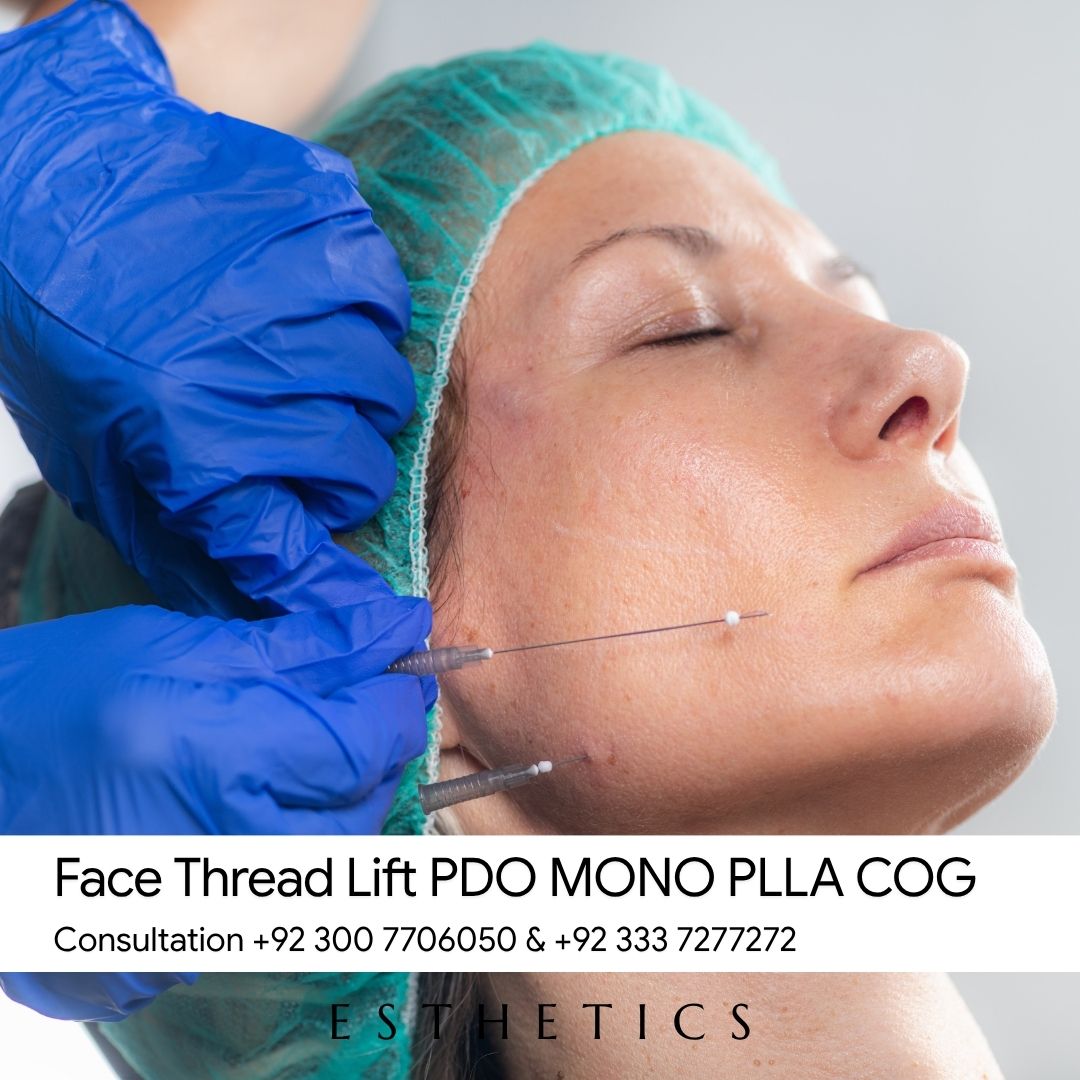
A thread lift in Pakistan is a minimally invasive cosmetic procedure designed to improve the appearance of mild to moderate facial skin laxity, redefine selected facial contours and create a subtle lifting effect without undergoing a traditional surgical facelift.
Also known as a face thread lift, thread facelift, PDO thread lift, non-surgical facelift or thread lifting, the procedure involves placing specially designed medical threads beneath the skin. Depending on the thread material and design, the threads may provide mechanical support while also stimulating a healing response and collagen remodeling.
Thread lifts have become part of the broader field of minimally invasive facial rejuvenation. Modern procedures commonly use absorbable materials such as polydioxanone (PDO), poly-L-lactic acid (PLLA), or polycaprolactone (PCL), although thread materials, designs and treatment techniques vary.
Recent evidence suggests that appropriately selected patients can experience immediate aesthetic improvement following absorbable thread lifting, but long-term evidence remains limited. A 2024 review of absorbable facial thread lifts found improvement across the studies it analyzed, while also emphasizing that long-term efficacy data are still lacking.
This is why a thread lift should not be marketed as an identical replacement for a surgical facelift.
Instead, it can be considered a minimally invasive option for selected patients who want facial rejuvenation with less downtime than traditional surgery.
What Is a Thread Lift?
A thread lift is a minimally invasive aesthetic procedure in which specially designed threads are inserted beneath the skin to provide support and, depending on their design, a lifting or repositioning effect.
Some threads are smooth and primarily intended to stimulate tissue remodeling, while lifting threads may have:
- Cogs
- Barbs
- Cones
- Anchoring features
These structures can help provide mechanical support to selected facial tissues.
Many modern thread-lift systems use absorbable materials. The threads gradually break down over time while the surrounding tissue undergoes remodeling.
The uploaded reference describes thread lifts as procedures using dissolvable threads that create a supportive framework beneath the skin and may stimulate collagen production as the material is absorbed.
Thread Lift vs Surgical Facelift
One of the most important questions patients ask is:
“Is a thread lift the same as a facelift?”
No.
Although both procedures aim to improve facial laxity, they are fundamentally different.
A surgical facelift involves incisions and surgical manipulation of facial tissues. Depending on the technique, excess skin may be removed and deeper tissues may be repositioned.
A thread lift uses strategically placed threads to provide temporary support and stimulate tissue remodeling without the larger incisions associated with facelift surgery.
| Feature | Thread Lift | Surgical Facelift |
|---|---|---|
| Surgical incisions | Minimal injection/access points | Yes |
| Skin removal | No | May be performed |
| Tissue repositioning | Limited/mechanical | More extensive |
| Downtime | Usually shorter | Longer |
| Results | More subtle | More substantial |
| Longevity | Temporary/variable | Generally longer |
| Best suited to | Mild/moderate laxity | More advanced laxity |
The evidence also cautions against presenting thread lifting as a direct replacement for rhytidectomy. Earlier long-term research found that thread lifts could provide limited and short-lived improvement, while more recent reviews continue to identify gaps in long-term evidence.
How Does a Thread Lift Work?
A thread lift generally works through two related mechanisms.
1. Mechanical Support
Lifting threads can provide temporary physical support to selected facial tissues.
Depending on the technique, the practitioner may use the threads to improve the appearance of:
- Jowls
- Lower-face laxity
- Cheek descent
- Jawline definition
- Selected neck laxity
2. Tissue Remodeling
Absorbable threads may also stimulate a local tissue-healing response.
Over time, collagen remodeling around the treated area may contribute to changes in:
- Skin firmness
- Texture
- Support
- Facial contour
The degree of lifting depends on the thread design, treatment technique, anatomy and amount of tissue laxity.
What Areas Can Be Treated With a Thread Lift?
A thread lift can be customized according to the patient’s facial anatomy and treatment goals.
Common treatment areas include:
Mid-Face
Thread lifting may be used to improve the appearance of mild cheek descent and restore some facial contour.
Lower Face
The lower face is one of the most common areas considered for thread lifting.
Treatment may target:
- Jowls
- Lower-face laxity
- Jawline definition
Jawline
A thread lift may help create a more defined jawline when mild skin laxity is contributing to reduced definition.
Neck
Selected patients may undergo thread treatment for mild neck laxity.
Brows
Certain thread techniques may be used for subtle brow elevation.
Cheeks
Threads may be placed to provide support and improve selected areas of cheek laxity.
The uploaded source identifies the mid-face, lower face and neck as common regions addressed in facial lifting procedures.
Types of Thread Lift
There are several types of threads used in aesthetic medicine.
The most commonly discussed materials include:
- PDO
- PLLA
- PCL
Other thread systems and branded designs may use different structures, such as cones or cogs.
The important point is that thread type should be selected according to the patient’s anatomy and treatment goal rather than simply choosing the most expensive thread.
PDO Thread Lift
PDO (polydioxanone) threads are absorbable medical threads that have been widely used for minimally invasive facial rejuvenation.
PDO threads can be designed as:
- Smooth threads
- Twisted threads
- Barbed/cog threads
Smooth PDO threads are often used more for tissue stimulation and skin-quality improvement, whereas lifting PDO threads are designed to provide mechanical support.
The uploaded reference describes PDO threads as dissolvable and notes their use for areas including the cheeks, jawline and neck.
However, the exact longevity should not be guaranteed because results vary significantly between patients and techniques.
PLLA Thread Lift
Poly-L-lactic acid (PLLA) is another material used in some absorbable thread systems.
PLLA is known for its biostimulatory properties and has also been extensively investigated in other facial aesthetic applications.
A 2024 systematic review of PLLA in facial aesthetics found improvements in several clinical outcomes, although the authors rated the overall evidence quality as low and noted that further investigation is needed.
Therefore, claims that PLLA threads always produce a particular duration of results should be avoided.
PCL Thread Lift
Polycaprolactone (PCL) is another absorbable material used in certain thread systems.
PCL is valued for its combination of structural properties and biostimulatory potential.
The uploaded reference identifies PCL threads as an option for facial rejuvenation and discusses their longevity, versatility and dependence on practitioner expertise.
As with all thread procedures, outcomes vary according to:
- Thread design
- Number of threads
- Placement
- Patient anatomy
- Skin quality
- Degree of laxity
- Practitioner technique
Cog Threads
Cog threads contain barbs or cog-like structures that can engage tissue and provide a stronger lifting effect than smooth threads.
They are commonly discussed for:
- Jawline lifting
- Lower-face contouring
- Jowls
- Cheek lifting
The uploaded source describes cog threads as designed to provide more pronounced lifting and notes that placement must be symmetrical and technically precise.
Because of their design, proper anatomical knowledge and practitioner experience are especially important.
Silhouette-Type Thread Systems
Some thread systems use cones rather than traditional barbs.
These systems are designed to provide tissue engagement and lifting while using absorbable materials in certain formulations.
The uploaded source discusses Silhouette InstaLift and describes its use for areas such as the mid-face and jowls.
Patients should ask exactly which product is being used because branded thread systems can differ in composition, regulatory status and intended use.
Are Thread Lifts Non-Surgical?
Thread lifts are generally described as minimally invasive rather than completely non-invasive.
This distinction is important.
The skin is penetrated to insert the threads, so the procedure is not equivalent to treatments such as:
- HIFU
- Radiofrequency
- Certain laser treatments
There are nevertheless no large surgical incisions like those used for a conventional facelift.
Benefits of Thread Lift Treatment
Potential benefits of an appropriately performed thread lift include:
Minimally invasive approach
Compared with surgical facelift procedures, thread lifting generally requires much smaller access points.
Shorter recovery
Downtime is generally less than with major facial surgery, although swelling and bruising can occur.
Subtle lifting
The procedure can provide a more lifted appearance in selected patients.
Facial contouring
Treatment can improve the appearance of selected areas such as the jawline and jowls.
Collagen remodeling
Absorbable threads may contribute to tissue remodeling.
Customized treatment
Threads can be placed according to individual facial anatomy.
No traditional facelift scar
Thread lifting does not require the long incisions associated with conventional facelift surgery.
The source article similarly identifies minimally invasive treatment, targeted improvement and relatively quick recovery among the major advantages of thread lifts.
Who Is a Good Candidate for a Thread Lift?
A thread lift may be considered for adults who have:
- Mild to moderate skin laxity
- Early jowling
- Mild cheek descent
- Reduced jawline definition
- Early signs of facial aging
- Realistic expectations
- A preference for minimally invasive treatment
The procedure is generally less suitable for patients with substantial excess skin or severe facial tissue descent.
A consultation is necessary to determine whether the expected benefit is sufficient.
Who May Not Be a Good Candidate?
A thread lift may not be appropriate for someone with:
- Severe skin laxity
- Significant excess skin
- Certain active skin infections
- Certain medical conditions
- Unrealistic expectations
- Poor wound healing
- Certain bleeding or medication-related concerns
The final decision should be made after medical assessment.
Thread Lift Procedure
The exact technique depends on the thread system and treatment area.
A typical procedure involves:
Step 1: Consultation
The practitioner evaluates facial anatomy and discusses the desired outcome.
Step 2: Treatment Planning
The treatment areas and thread type are selected.
Step 3: Facial Mapping
The practitioner may mark planned entry points and thread trajectories.
Step 4: Skin Preparation
The treatment area is cleaned and prepared using appropriate infection-control measures.
Step 5: Local Anesthesia
Local anesthetic or another appropriate method of pain control may be used.
Step 6: Thread Placement
The threads are inserted beneath the skin along predetermined paths.
Step 7: Lifting/Positioning
For lifting threads, controlled tension may be applied to create the desired support.
Step 8: Finishing
The practitioner checks symmetry and treatment contours before completing the procedure.
Step 9: Aftercare
The patient receives individualized post-treatment instructions.
How Long Does a Thread Lift Take?
Treatment time varies according to:
- Number of threads
- Treatment areas
- Thread design
- Technique
- Facial anatomy
- Whether other procedures are performed at the same time
A smaller treatment may take considerably less time than a comprehensive lower-face and neck procedure.
A specialist can provide a more accurate estimate during consultation.
Is a Thread Lift Painful?
Some discomfort is possible.
Patients may experience:
- Pressure
- Pinching
- Pulling
- Mild burning
- Tenderness
- Temporary soreness
Local anesthesia or other comfort measures can be used depending on the procedure.
Pain tolerance varies from person to person.
Thread Lift Recovery
One of the reasons people choose thread lifting is the generally shorter recovery compared with surgical facelift procedures.
However, minimal downtime does not mean zero downtime.
Temporary effects may include:
- Swelling
- Bruising
- Tenderness
- Tightness
- Mild asymmetry
- Skin dimpling
These generally improve as healing progresses, although the recovery period varies.
Thread Lift Aftercare
Your practitioner may advise you to temporarily avoid activities that place excessive pressure or movement on the treated area.
Depending on the procedure, aftercare may include:
- Sleeping with the head elevated
- Avoiding vigorous exercise temporarily
- Avoiding excessive facial manipulation
- Following prescribed medication instructions
- Attending follow-up appointments
- Avoiding unnecessary pressure on treated areas
Your treating professional’s instructions should take priority over generic online recommendations.
Thread Lift Results
One of the biggest advantages of a thread lift can be the combination of an early lifting effect with gradual tissue remodeling.
Some patients notice an improvement shortly after treatment.
However, swelling can initially distort the appearance.
As swelling decreases and tissue remodeling occurs, the appearance may change further.
A 2024 review of absorbable thread lifts found immediate improvement across the included studies, but also noted that the longest follow-ups were only around two years and that long-term efficacy data remain limited.
Therefore, patients should avoid promises of a specific guaranteed result.
How Long Do Thread Lift Results Last?
This is one of the most misunderstood aspects of thread lifting.
Results are temporary and variable.
The duration depends on:
- Thread material
- Thread design
- Treatment technique
- Patient age
- Skin quality
- Degree of laxity
- Lifestyle
- Weight changes
- Individual healing response
Some sources and clinics describe results lasting several months to approximately one or two years, but scientific evidence does not justify a single guaranteed duration for every patient.
A systematic review and meta-analysis found that satisfaction tends to decrease over time, reinforcing the importance of discussing the temporary nature of the procedure.
Can Thread Lifts Permanently Stop Aging?
No.
A thread lift does not stop the natural aging process.
The skin, muscles, fat compartments and supporting structures continue to change with age.
Therefore, maintenance treatments may sometimes be considered.
The goal should be improvement, not permanent prevention of aging.
Thread Lift Before and After
Before-and-after photographs can be useful for demonstrating potential outcomes.
However, results should not be interpreted as guarantees.
Different patients may have very different outcomes because of:
- Facial anatomy
- Skin elasticity
- Fat distribution
- Thread selection
- Treatment technique
- Number of threads
- Age
- Degree of laxity
When evaluating before-and-after images, look for photographs taken under comparable:
- Lighting
- Facial expression
- Camera angle
- Distance
- Time after treatment
Thread Lift Side Effects
Thread lifting can cause temporary side effects.
Commonly reported effects include:
- Swelling
- Bruising
- Pain or tenderness
- Skin dimpling
- Temporary asymmetry
- Numbness
- Thread visibility or palpability
A systematic review of facial thread lifting found swelling to be the most commonly reported complication, followed by skin dimpling, paresthesia, visible or palpable threads, infection and thread extrusion.
A newer systematic review of absorbable thread materials similarly identified bruising, swelling and tenderness among the most frequently reported complications.
Serious Thread Lift Complications
Serious complications are uncommon but possible.
They may include:
- Infection
- Persistent inflammation
- Thread extrusion
- Thread migration
- Significant asymmetry
- Nerve-related symptoms
- Injury to nearby structures
- Contour irregularity
An evidence-based systematic review involving more than 14,000 patients found that most adverse effects were transient, while serious events such as injuries to vessels or glands, infections and inflammatory reactions were less common.
This reinforces why the procedure should be performed by a qualified and experienced practitioner with appropriate knowledge of facial anatomy.
Why Practitioner Experience Matters
A thread lift is highly technique-dependent.
The practitioner must understand:
- Facial anatomy
- Skin thickness
- Fat compartments
- Nerves
- Blood vessels
- Thread vectors
- Appropriate insertion planes
- Symmetry
- Appropriate patient selection
The source material also emphasizes that successful outcomes depend heavily on practitioner expertise.
A technically poor thread lift can result in:
- Uneven lifting
- Dimpling
- Visible threads
- Palpable threads
- Asymmetry
- Infection
- Poor aesthetic outcome
Thread Lift Cost in Pakistan
The thread lift cost in Pakistan varies from patient to patient.
There is no single price that applies to every procedure.
Factors affecting cost include:
Type of thread
PDO, PLLA, PCL and other systems may have different costs.
Number of threads
A treatment using a small number of threads will generally differ in price from a comprehensive lifting procedure.
Treatment area
Jawline, cheeks, brow and neck treatment can have different requirements.
Practitioner experience
Specialist expertise and training may influence the treatment fee.
Clinic standards
Medical facility, sterilization, equipment and follow-up arrangements can influence overall cost.
Combination procedures
If other aesthetic procedures are performed, the total cost will change.
The uploaded source similarly identifies location, practitioner expertise, thread type, number of threads and clinic facilities as major factors influencing thread-lift cost.
Thread Lift Price in Pakistan
Patients searching for thread lift price in Pakistan should be cautious about websites advertising one fixed price without knowing:
- Which thread is being used
- How many threads are required
- Which facial area is being treated
- Who will perform the procedure
- Whether consultation and follow-up are included
A personalized quotation after assessment is more meaningful than a generic online price.
Thread Lift in Islamabad
Thread lift in Islamabad is commonly searched by patients interested in minimally invasive facial rejuvenation.
People may seek treatment for:
- Jowls
- Jawline laxity
- Cheek sagging
- Facial contour
- Mild neck laxity
- Early signs of aging
A specialist consultation can determine whether a thread lift is appropriate or whether another treatment would provide a better result.
Thread Lift in Rawalpindi
Patients searching for thread lift in Rawalpindi may similarly be interested in non-surgical or minimally invasive facial lifting.
The same medical considerations apply.
Treatment should be selected based on the patient’s anatomy rather than simply choosing a particular thread because it is popular online.
Thread Lift in Lahore
Thread lift in Lahore is another high-intent search term for people considering facial rejuvenation.
Patients should ask about:
- Thread material
- Manufacturer
- Practitioner qualifications
- Number of threads
- Expected results
- Risks
- Recovery
- Follow-up
Thread Lift in Karachi
Patients searching for thread lift in Karachi should also focus on medical expertise and product quality.
A lower price does not necessarily mean better value.
For a procedure involving facial anatomy, practitioner experience and safe technique should be major considerations.
Thread Lift in Pakistan for Men
Thread lifts are not limited to women.
Men may consider facial thread lifting for:
- Jawline definition
- Mild jowls
- Lower-face laxity
- Neck laxity
- Early facial aging
Treatment should be customized according to male facial anatomy.
Thread Lift for Women
Women commonly seek thread lifting for:
- Cheek lifting
- Jawline definition
- Jowl reduction
- Facial contouring
- Neck tightening
- Brow elevation
Again, the appropriate procedure depends on anatomy rather than gender alone.
Thread Lift vs HIFU
Both treatments can be used for non-surgical facial rejuvenation, but they work differently.
Thread lift:
Uses threads placed beneath the skin to provide mechanical support and tissue remodeling.
HIFU:
Uses focused ultrasound energy to create controlled tissue effects without inserting threads.
Thread lifting may be more appropriate when a patient wants a mechanical lifting effect.
HIFU may be considered when skin tightening is the primary concern.
A specialist can determine which option is more suitable.
Thread Lift vs Dermal Fillers
Dermal fillers and thread lifts are also different.
Fillers can restore or add volume.
Thread lifts are primarily designed around lifting/supporting selected tissues and, with absorbable threads, tissue remodeling.
In some patients, a combination treatment may be considered.
However, combination procedures should be based on facial anatomy rather than automatically combining treatments.
Thread Lift vs Botox
Botulinum toxin primarily affects muscle activity.
Thread lifting addresses selected areas of tissue laxity.
Therefore, they are not direct alternatives.
A patient may require one, the other or neither depending on the concern.
Thread Lift vs Surgical Facelift
A thread lift may be suitable for mild-to-moderate laxity.
A surgical facelift can provide substantially more correction for patients with significant:
- Skin excess
- Jowling
- Tissue descent
- Neck laxity
The appropriate choice depends on the patient’s goals and anatomy.
Can a Thread Lift Replace a Facelift?
For some patients seeking a modest, minimally invasive improvement, a thread lift may be an alternative to consider.
But it should not be presented as equivalent to surgery.
Evidence reviews have repeatedly highlighted uncertainty about long-term durability.
Patients with substantial facial aging may achieve more predictable and substantial correction through a surgical facelift.
How Many Threads Are Needed?
There is no universal number.
The number depends on:
- Facial anatomy
- Treatment area
- Degree of laxity
- Thread design
- Desired correction
- Practitioner technique
A treatment plan should therefore be individualized.
A clinic promising the same number of threads for every patient may not be providing genuinely customized treatment.
Is Thread Lift Worth It?
For an appropriately selected patient, a thread lift may offer an attractive balance between:
Less invasiveness + shorter recovery + subtle lifting.
But patients should understand its limitations.
The treatment is not permanent, and the evidence for long-term efficacy remains less robust than the evidence available for established surgical facelift procedures.
A realistic patient may be someone who says:
“I want some improvement, but I am not ready for a surgical facelift.”
That is often a more appropriate expectation than:
“I want the same result as a surgical facelift without surgery.”
How to Choose the Best Thread Lift Clinic in Pakistan
Before booking a procedure, ask:
1. Who will perform the treatment?
Ask about qualifications, training and experience.
2. What thread will be used?
Find out the material and design.
3. Is the thread absorbable?
Ask how long the material is expected to remain and what evidence supports its use.
4. How many threads are recommended?
The practitioner should explain why.
5. What results are realistic?
Avoid guaranteed-result claims.
6. What are the possible complications?
A responsible practitioner should discuss them.
7. What happens if a complication occurs?
Ask about follow-up and management.
8. Is a surgical facelift or another procedure more appropriate?
A good practitioner should be willing to recommend another option when appropriate.
What Happens During a Thread Lift Consultation?
A specialist consultation may involve:
Facial assessment
The practitioner evaluates:
- Skin laxity
- Jowls
- Cheek position
- Jawline
- Neck
- Facial symmetry
Medical history
Previous procedures, medications, allergies and relevant medical conditions may be discussed.
Treatment goals
You explain what you want to improve.
Thread selection
The practitioner determines which thread system may be appropriate.
Treatment planning
The areas, number of threads and technique are discussed.
Risk discussion
Potential complications are explained.
Cost
A personalized treatment estimate can be provided.
Frequently Asked Questions About Thread Lift in Pakistan
What is a thread lift?
A thread lift is a minimally invasive facial rejuvenation procedure that places specially designed threads under the skin to provide support and, depending on the thread, a lifting effect.
Is a thread lift permanent?
No. Results are temporary and vary between patients.
How long does a thread lift last?
Results can vary from several months to longer periods depending on thread type, technique and patient factors. Long-term evidence remains limited.
Is a thread lift better than a facelift?
Not necessarily. A thread lift is less invasive but generally produces more subtle results. Surgery can provide greater correction for advanced laxity.
Is a thread lift painful?
Some discomfort, pressure or tenderness can occur, but local anesthetic and other comfort measures can be used.
How long is recovery?
Recovery is generally shorter than surgical facelift recovery, although swelling and bruising may occur.
Can thread lifts remove jowls?
They may improve the appearance of mild jowling in appropriately selected patients.
Can thread lifts define the jawline?
They may improve jawline definition when mild skin laxity is contributing to the problem.
Can a thread lift treat the neck?
Selected thread techniques may be used for mild neck laxity.
What are PDO threads?
PDO threads are absorbable threads made from polydioxanone and are widely used in aesthetic thread-lifting procedures.
What are PCL threads?
PCL threads use polycaprolactone, an absorbable material used in certain aesthetic thread systems.
What are PLLA threads?
PLLA threads use poly-L-lactic acid, a material known for its biostimulatory properties.
What are cog threads?
Cog threads contain barbs or cog-like structures designed to engage tissue and provide lifting support.
How many threads are required?
The number depends on the patient’s anatomy, treatment area and desired result.
Can thread lifts cause complications?
Yes. Swelling, bruising, dimpling, numbness, visible threads, infection and other complications have been reported.
Can threads become visible?
In some cases, threads can become visible or palpable, particularly if placement or tissue coverage is unfavorable.
Can thread lifts be removed?
Some threads can be removed, but removal can itself be a medical procedure and may carry risks.
Are thread lifts suitable for older patients?
Age alone does not determine suitability. The degree of laxity, tissue quality and medical status are more important. However, studies have found some complications may be more common in older patients.
Can men have thread lifts?
Yes. Men can undergo appropriately planned thread lifting.
How much does a thread lift cost in Pakistan?
The price varies according to thread type, number of threads, treatment area, practitioner and clinic. A consultation is required for an individualized estimate.
Thread Lift Cost in Pakistan: What Determines Your Final Price?
If you are searching for thread lift cost in Pakistan, remember that there is no medically meaningful single price.
The total treatment cost can depend on:
Thread material
PDO, PLLA and PCL systems may have different costs.
Number of threads
More extensive lifting generally requires more material.
Treatment area
Jawline, cheeks, brows and neck can require different treatment plans.
Practitioner
Experience and qualifications may influence fees.
Clinic
Facility standards and follow-up can affect the overall cost.
Combination treatment
Additional aesthetic procedures can change the total cost.
The best approach is to obtain a personalized quotation after examination rather than relying on a generic online figure.
Thread Lift Results: What Should You Expect?
The most realistic expectation is subtle to moderate improvement, depending on the patient.
A thread lift may improve:
- Facial contour
- Mild laxity
- Jawline definition
- Jowling
- Selected cheek descent
- Skin firmness
It should not be expected to:
- Remove significant excess skin
- Reverse advanced aging
- Produce a permanent facelift
- Guarantee symmetrical results in every patient
The 2024 review of absorbable facial thread lifts found immediate improvements but also emphasized the lack of robust long-term data.
The Future of Thread Lifting
Thread-lift technology continues to evolve.
Recent literature has explored:
- New absorbable materials
- Different thread geometries
- Combination procedures
- Improved insertion techniques
- Better understanding of facial anatomy
- Patient-selection strategies
A large 2025 multicenter review of more than 111,000 facial thread-lifting procedures reported increasing use of thread lifting within multimodal facial rejuvenation and highlighted the evolving role of the procedure.
However, large procedure volumes should not be interpreted as proof that thread lifting is universally effective or permanent.
Clinical evidence and long-term outcomes remain important.
Final Verdict: Is Thread Lift a Good Facial Rejuvenation Option?
A thread lift in Pakistan can be an attractive minimally invasive option for carefully selected patients who want improvement in mild-to-moderate facial laxity without undergoing a traditional facelift.
Modern absorbable thread systems can provide an immediate aesthetic effect, while tissue remodeling may contribute to subsequent improvement. Recent evidence supports short-term effectiveness in appropriate patients, but long-term durability remains less certain.
The procedure may be particularly suitable for patients seeking:
- Subtle facial lifting
- Jawline definition
- Mild jowl improvement
- Cheek support
- Limited downtime
- A minimally invasive approach
Patients with substantial skin excess or advanced facial laxity may be better candidates for surgical facelift procedures.
The most important factors are:
Correct patient selection + appropriate thread + precise technique + realistic expectations + qualified practitioner.
Thread Lift Specialist Consultation in Pakistan
If you are considering a thread lift in Pakistan, PDO threads, PCL threads, PLLA threads, jawline thread lift, face thread lift, jowl lift, cheek lift or another minimally invasive facial rejuvenation procedure, the first step should be a specialist consultation.
During consultation, your facial anatomy, degree of laxity, skin quality and aesthetic goals can be assessed.
The specialist can then determine whether a thread lift is appropriate—or whether another option such as HIFU, fillers, skin tightening treatment or a surgical facelift would better match your goals.
Looking for Thread Lift Treatment in Pakistan?
For specialist aesthetic consultation and treatment information, visit:
The consultation allows the specialist to discuss your concerns, assess your suitability and explain the appropriate treatment options, expected results, cost and potential risks.