
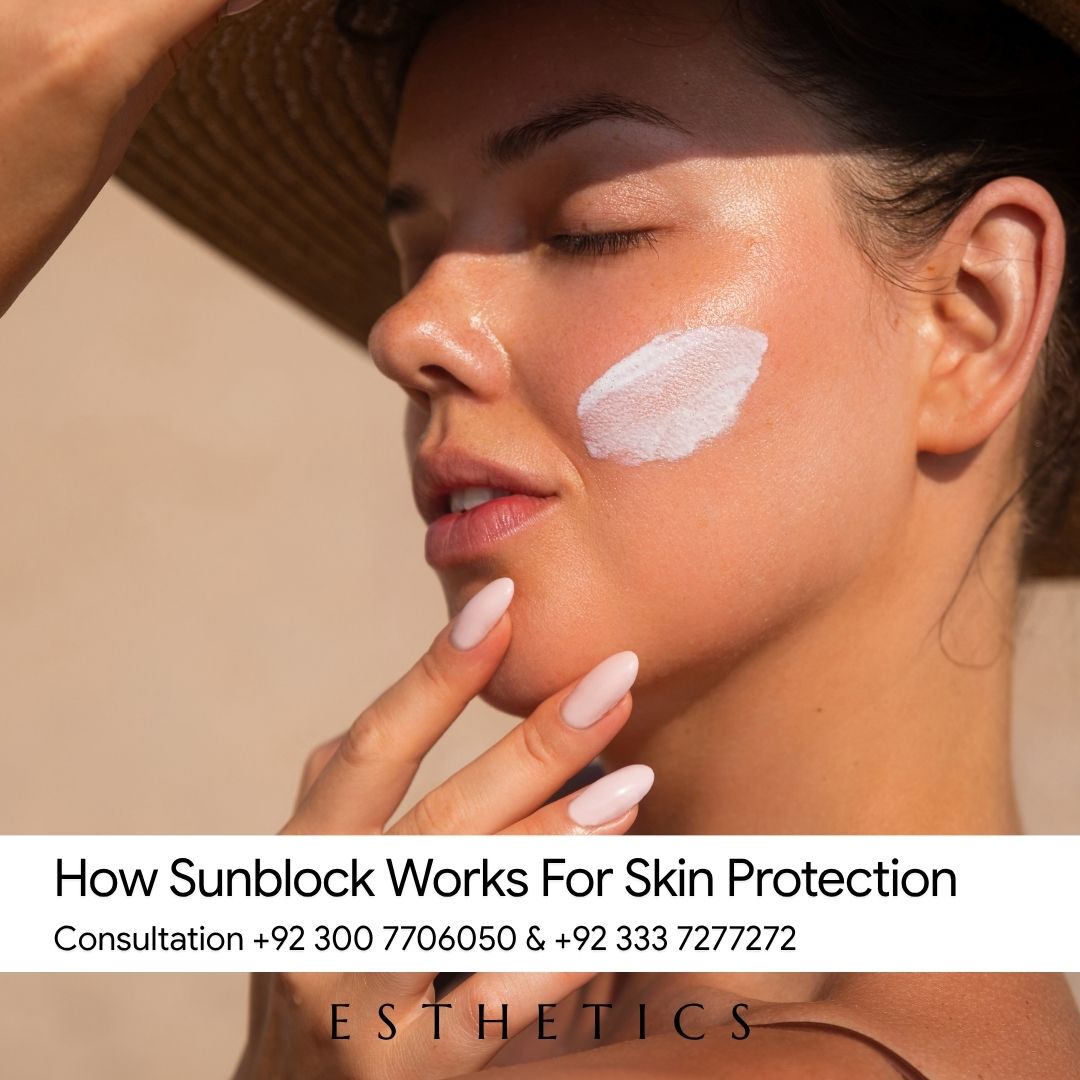
Sunblock, more accurately called sunscreen, is one of the most important products in a daily skincare routine. It helps reduce the amount of ultraviolet (UV) radiation reaching the skin and can help protect against sunburn, premature skin aging and UV-related skin damage. Broad-spectrum sunscreen protects against both UVA and UVB radiation, two major types of ultraviolet radiation that can damage the skin.
Many people think sunscreen is only necessary during summer or when spending a long time outdoors. In reality, UV exposure occurs throughout the year, and everyday exposure can contribute to cumulative skin damage.
Understanding how sunblock works, what SPF means, how much sunscreen to apply and when to reapply can help you build a more effective sun-protection routine.
What Is Sunblock?
Sunblock is a common term used for products designed to protect the skin from ultraviolet radiation.
Today, the more accurate general term is sunscreen.
Sunscreens contain active ingredients that help reduce UV radiation reaching the skin. Depending on the formulation, these ingredients can absorb, reflect or scatter portions of UV radiation. FDA information describes sunscreen active ingredients as the components responsible for protecting the skin from harmful ultraviolet rays.
Sunscreens are available in many forms, including:
- Creams
- Lotions
- Gels
- Sticks
- Sprays
- Oils
- Moisturizers containing sunscreen
The best sunscreen is generally one that provides appropriate protection and that you can comfortably apply consistently.
Why Does the Skin Need Protection From the Sun?
Sunlight contains ultraviolet radiation that can damage skin cells.
The two types of UV radiation most relevant to sunscreen protection are:
- UVA
- UVB
Both can contribute to skin damage, but they affect the skin in somewhat different ways.
Repeated UV exposure can contribute to:
- Sunburn
- Premature skin aging
- Uneven pigmentation
- Dark spots
- Loss of skin elasticity
- DNA damage
- Increased skin-cancer risk
The FDA notes that unprotected sun exposure increases the risk of skin cancer and early skin aging.
This is why sunscreen is not simply a cosmetic product.
It is an important component of sun protection.
What Is UVA Radiation?
UVA has a longer wavelength than UVB and penetrates deeper into the skin.
UVA exposure is associated with photoaging and contributes to skin damage.
Long-term exposure can contribute to changes such as:
- Fine lines
- Wrinkles
- Loss of elasticity
- Uneven pigmentation
- Photoaging
UVA also contributes to skin-cancer risk.
Because SPF primarily measures protection against sunburn, which is mainly associated with UVB, choosing a broad-spectrum sunscreen is important when you want protection against both UVA and UVB.
What Is UVB Radiation?
UVB has a shorter wavelength and is strongly associated with sunburn.
UVB can damage DNA in skin cells and contributes to skin cancer.
It is also the primary type of UV radiation measured by the conventional SPF test.
This is why SPF is primarily an indicator of UVB-related sunburn protection.
However, choosing a high SPF alone does not mean that you are receiving adequate UVA protection.
For broader protection, look for a sunscreen labeled broad spectrum.
How Does Sunblock Work?
Sunscreen works by reducing the amount of UV radiation that reaches and affects the skin.
The active sunscreen ingredients interact with UV radiation before it can cause as much damage to the underlying skin.
Depending on the type of sunscreen, protection may involve:
Absorbing UV radiation
Some sunscreen ingredients absorb UV radiation and reduce the amount reaching living skin cells.
Reflecting or scattering radiation
Certain mineral sunscreen ingredients can reflect and scatter UV radiation and also absorb UV.
Creating a protective layer
When sunscreen is evenly applied, it creates a layer over the skin containing active ingredients that help reduce UV exposure.
The FDA describes sunscreen as providing a protective barrier that absorbs or reflects UV radiation before it can damage the skin.
Chemical vs Mineral Sunscreen
Sunscreens are often broadly categorized as:
- Chemical/organic sunscreens
- Mineral/inorganic sunscreens
The distinction primarily relates to the sunscreen’s active ingredients.
Chemical Sunscreens
Chemical sunscreen formulations may contain organic UV filters that absorb UV radiation.
Examples of sunscreen active ingredients used in various formulations include:
- Avobenzone
- Octocrylene
- Octisalate
- Octinoxate
- Ecamsule
- Other approved UV filters depending on the country
Regulatory approval and permitted sunscreen ingredients differ between countries.
Mineral Sunscreens
Mineral sunscreens commonly use:
- Zinc oxide
- Titanium dioxide
These ingredients provide UV protection through a combination of absorption, scattering and reflection.
The FDA identifies zinc oxide and titanium dioxide among sunscreen active ingredients used in regulated sunscreen products.
What Does SPF Mean?
SPF stands for Sun Protection Factor.
SPF primarily measures protection against UVB-related sunburn.
For example, an SPF 30 product provides substantially more protection against UVB-induced sunburn than an SPF 15 product when both are properly applied.
However, SPF does not mean that you can stay in the sun for 30 times longer without risk.
This is a common misconception.
The FDA specifically explains that SPF is not a measure of how many hours you can remain in the sun. It relates to the amount of UV radiation required to produce sunburn on protected versus unprotected skin.
SPF 30 vs SPF 50
Many people wonder whether SPF 50 is significantly better than SPF 30.
Both can provide substantial protection when applied correctly.
However, the difference in protection is not simply:
SPF 50 = 50 times more protection than SPF 1.
SPF represents a specific testing measurement rather than a simple percentage scale.
For everyday use, dermatologists commonly recommend a broad-spectrum sunscreen with SPF 30 or higher. The American Academy of Dermatology recommends SPF 30 or higher, broad-spectrum coverage and water resistance for routine sun protection.
Does SPF 100 Mean Complete Protection?
No.
No sunscreen blocks all UV radiation.
A higher SPF can provide greater sunburn protection, but it does not provide 100% protection.
It is also important to remember that:
- Sunscreen can wear off
- Sunscreen can be missed during application
- Sweating can reduce coverage
- Swimming can remove sunscreen
- Clothing and shade remain important
- Sunscreen does not eliminate UV exposure
The FDA emphasizes that no sunscreen completely blocks UV radiation and recommends combining sunscreen with other sun-protection measures.
What Does Broad Spectrum Mean?
Broad spectrum means the sunscreen provides protection against both:
- UVA
- UVB
This is important because SPF primarily reflects UVB/sunburn protection.
A sunscreen with a high SPF but without broad-spectrum protection may not provide the level of UVA protection you are looking for.
For comprehensive daily protection, look for a product labeled:
Broad Spectrum SPF 30+
or an equivalent labeling system applicable in your country.
The FDA specifically explains that broad-spectrum sunscreens provide protection against both UVA and UVB radiation.
Why Sunscreen Helps Prevent Premature Skin Aging
Repeated UV exposure contributes significantly to photoaging.
Photoaging can appear as:
- Fine lines
- Wrinkles
- Uneven pigmentation
- Rough skin texture
- Loss of elasticity
- Sunspots
UVA exposure plays an important role in photoaging.
Using sunscreen consistently can reduce the amount of UV radiation reaching the skin and therefore help reduce cumulative sun damage.
This is why sunscreen is often considered one of the most important anti-aging skincare products.
The FDA states that appropriate broad-spectrum sunscreen use, together with other sun-protection measures, can help reduce the risk of early skin aging caused by the sun.
Sunscreen and Dark Spots
UV exposure can contribute to pigmentation and can make existing dark spots more noticeable.
This can be particularly important for people who are prone to:
- Melasma
- Post-inflammatory hyperpigmentation
- Sunspots
- Uneven skin tone
Consistent sun protection can help reduce continued UV stimulation of pigmentation.
For people particularly concerned about pigmentation, dermatologists may sometimes recommend tinted sunscreen containing iron oxides, because these formulations can also provide protection against some visible light. The American Academy of Dermatology notes that tinted sunscreen with iron oxide can offer additional protection against dark spots.
How Much Sunscreen Should You Apply?
Using too little sunscreen can significantly reduce the protection you actually receive.
For exposed body skin, the FDA advises applying sunscreen liberally; approximately one ounce, roughly enough to fill a shot glass, is commonly used as an estimate for covering an average adult’s exposed body.
For the face and neck, many dermatology professionals use the two-finger method as a practical way to estimate an adequate amount, although the exact amount depends on the product and area being covered.
The important principle is:
Do not apply a very thin layer simply to make the sunscreen disappear quickly.
Adequate coverage matters.
How Should Sunscreen Be Applied?
A simple sunscreen routine can include the following steps:
Step 1: Apply to exposed skin
Cover areas that will be exposed to sunlight.
Do not forget:
- Face
- Ears
- Neck
- Hands
- Forehead
- Hairline
- Chest
- Feet when exposed
The FDA specifically recommends paying attention to areas such as the nose, ears, neck, hands, feet and lips.
Step 2: Apply before going outside
The American Academy of Dermatology recommends applying sunscreen before going outdoors and notes that sunscreen should be applied approximately 15 minutes before outdoor exposure.
Step 3: Spread evenly
Make sure the sunscreen is distributed evenly rather than leaving uncovered patches.
Step 4: Reapply
Reapplication is essential because sunscreen can wear off through time, sweating, swimming and friction.
How Often Should You Reapply Sunscreen?
The FDA recommends reapplying sunscreen at least every two hours, and more frequently when swimming or sweating.
You may need to reapply sooner if:
- You are sweating heavily
- You swim
- You towel off
- You exercise outdoors
- Clothing rubs against the skin
- You spend prolonged time in direct sunlight
Water-resistant sunscreen can remain effective for a specified period during swimming or sweating, but no sunscreen is completely waterproof. FDA labeling distinguishes water-resistant products according to tested periods such as 40 or 80 minutes.
Is Sunscreen Necessary on Cloudy Days?
Yes.
Cloudy weather does not mean that UV exposure disappears.
UV radiation can still reach the skin on cloudy days.
The FDA recommends regular broad-spectrum sunscreen use even on cloudy days.
This is especially relevant for people who spend time outdoors or live in regions with strong sunlight.
Is Sunscreen Necessary in Winter?
For exposed skin, sun protection can still be important during winter.
UV exposure occurs year-round.
The intensity may vary depending on:
- Geographic location
- Season
- Time of day
- Altitude
- Cloud cover
- Surrounding reflective surfaces
Therefore, sunscreen should be considered part of a year-round sun-protection routine rather than a product used only during hot weather.
Sunscreen in Pakistan
Sun protection can be particularly important in Pakistan because many parts of the country experience substantial sunlight for much of the year.
People spending time outdoors may be exposed to significant UV radiation.
Daily sunscreen use can be especially useful for people concerned about:
- Sunburn
- Uneven pigmentation
- Melasma
- Dark spots
- Premature aging
- Outdoor work
- Driving
- Sports
- Travel
However, sunscreen should be combined with physical protection such as shade, hats and protective clothing.
Sunscreen for Different Skin Types
The best sunscreen is one that provides appropriate protection while working comfortably with your skin type.
Oily Skin
People with oily or acne-prone skin may prefer:
- Lightweight formulations
- Gel textures
- Fluid sunscreens
- Non-comedogenic products
Dry Skin
People with dry skin may prefer:
- Cream-based sunscreens
- Moisturizing formulations
- Hydrating ingredients
Sensitive Skin
Some people with sensitive skin may prefer mineral formulations containing zinc oxide or titanium dioxide.
However, individual tolerance varies.
Combination Skin
A lightweight lotion or fluid can be useful for combination skin.
The most important factor is consistency.
A sunscreen that feels comfortable enough to use every day is often more useful than one that is theoretically ideal but unpleasant to wear.
Sunscreen for Acne-Prone Skin
People with acne-prone skin may worry that sunscreen will make their skin oily or cause breakouts.
Modern formulations are available in lightweight and non-comedogenic options.
When selecting a sunscreen, consider:
- Oil-free or lightweight textures
- Non-comedogenic labeling
- Gel or fluid formulations
- Fragrance-free options if sensitive
If a particular sunscreen repeatedly causes irritation or breakouts, a dermatologist can help identify a better formulation.
Sunscreen and Melasma
Melasma is a pigmentation condition that can worsen with light exposure.
Sun protection is an important component of melasma management.
People with melasma may benefit from:
- Broad-spectrum sunscreen
- Consistent daily application
- Reapplication during prolonged outdoor exposure
- Hats and shade
- Tinted sunscreen with iron oxides in appropriate cases
The AAD notes that tinted sunscreen containing iron oxide can provide additional protection against visible light, which can be relevant for dark spots.
A dermatologist can recommend additional treatments if pigmentation persists.
Can Sunscreen Whiten the Skin?
Sunscreen does not directly “whiten” the skin.
Its main function is to reduce UV exposure.
By limiting UV-induced tanning and pigmentation, consistent sunscreen use can help prevent further darkening and may allow existing pigmentation treatments to work more effectively.
A sunscreen should therefore be viewed as a skin-protection product, not a skin-whitening treatment.
Can Sunscreen Remove Dark Spots?
Sunscreen alone does not necessarily remove established pigmentation.
However, it can help prevent UV exposure from worsening pigmentation.
For persistent dark spots, a dermatologist may recommend other treatments, depending on the cause.
Potential options may include:
- Topical medications
- Chemical peels
- Laser procedures
- Other dermatological treatments
The appropriate treatment depends on the diagnosis.
Sunscreen and Vitamin D
Vitamin D is important for health, but deliberately exposing unprotected skin to UV radiation is not generally recommended as a strategy for obtaining vitamin D.
If you are concerned about vitamin D deficiency, discuss testing, diet and supplementation with a healthcare professional.
Do not intentionally increase UV exposure because you believe sunscreen prevents all vitamin D production.
Does Sunscreen Cause Vitamin D Deficiency?
The relationship between sunscreen use and vitamin D status is more complicated than the common claim that sunscreen “blocks all vitamin D.”
Real-world sunscreen use is often imperfect, and people receive UV exposure from many sources.
If vitamin D status is a concern, the appropriate approach is to discuss it with a healthcare professional rather than abandoning sun protection.
Sunscreen and Makeup
Sunscreen can be incorporated into a makeup routine.
A practical order is generally:
Cleanser → skincare products → moisturizer if needed → sunscreen → makeup
Sunscreen should be applied evenly rather than relying solely on makeup products that contain SPF.
Makeup with SPF can provide additional protection, but it may not be applied in a sufficient quantity to replace dedicated sunscreen.
Can Moisturizer With SPF Replace Sunscreen?
It depends on the product and how much you apply.
A moisturizer labeled with an appropriate SPF and broad-spectrum protection can provide sun protection when applied adequately.
However, many people apply moisturizer much more sparingly than the amount used in sunscreen testing.
For significant sun exposure, a dedicated broad-spectrum sunscreen may be easier to use in an adequate amount.
Sunscreen for Men
Sunscreen is not gender-specific.
Men can experience:
- Sunburn
- Photoaging
- Pigmentation
- Skin cancer
- UV-related skin damage
Men who spend significant time outdoors, drive frequently or work outside should incorporate sun protection into their daily routine.
A lightweight sunscreen can be especially convenient for people who dislike heavy skincare products.
Sunscreen for Children
Children’s sun protection should involve more than sunscreen.
Useful measures include:
- Shade
- Protective clothing
- Hats
- Sunglasses
- Age-appropriate sunscreen
The FDA advises consulting a healthcare professional before applying sunscreen to infants younger than 6 months.
Parents should follow the product label and pediatric medical advice.
Can Sunscreen Prevent Skin Cancer?
Sunscreen is an important part of a broader strategy to reduce UV exposure and skin-cancer risk.
The FDA notes that broad-spectrum sunscreen, when used as directed together with other protective measures, can help reduce risks associated with sun exposure.
However, sunscreen does not provide complete protection.
Other measures remain important:
- Seek shade
- Wear protective clothing
- Use a broad-brimmed hat
- Wear sunglasses
- Avoid prolonged intense sun exposure
- Apply sunscreen properly
What Does “Water Resistant” Mean?
A water-resistant sunscreen is tested to determine how long it maintains its labeled SPF during swimming or sweating.
It may be labeled as water resistant for:
- 40 minutes
- 80 minutes
depending on the test results.
“Waterproof” is not an appropriate claim because sunscreen eventually wears away in water.
After swimming or heavy sweating, sunscreen should generally be reapplied according to the label.
Is “Sunblock” Better Than “Sunscreen”?
Not necessarily.
The term sunblock can imply that the product completely blocks sunlight, which is misleading.
The FDA has specifically stated that manufacturers should not use claims such as “waterproof,” “sweatproof” or “sunblock” because they can overstate a product’s effectiveness.
The more useful terms to look for are:
Broad Spectrum + SPF + Water Resistant, when needed.
How to Choose the Best Sunscreen
When selecting a sunscreen, consider these factors:
1. Broad spectrum
Choose protection against both UVA and UVB.
2. SPF 30 or higher
The AAD recommends SPF 30 or higher for routine sun protection.
3. Water resistance
Useful if you swim, sweat or participate in outdoor sports.
4. Skin type
Choose a texture compatible with your skin.
5. Comfort
A sunscreen you enjoy using is more likely to become part of your daily routine.
6. Pigmentation concerns
Tinted formulations containing iron oxide may be useful for people concerned about dark spots.
Common Sunscreen Mistakes
Even people who use sunscreen regularly can make mistakes.
Applying too little
Insufficient product can reduce the protection achieved.
Forgetting the ears
The ears are frequently exposed.
Forgetting the neck
The neck can receive substantial cumulative sun exposure.
Applying only once
Sunscreen wears off.
Skipping sunscreen on cloudy days
UV radiation can still reach exposed skin.
Relying on SPF makeup alone
The amount of makeup applied may be insufficient.
Thinking SPF is a timer
SPF does not mean you can safely stay outside for a predetermined number of hours.
Does Sunscreen Expire?
Yes.
Sunscreen products should be stored and used according to their labeling.
Expired or improperly stored sunscreen may not provide the expected protection.
Check:
- Expiry date
- Product appearance
- Smell
- Texture
- Storage instructions
If the product has changed significantly or is past its labeled expiration, replace it.
Can Sunscreen Be Used Every Day?
For most people, daily sunscreen is an important part of routine sun protection.
It can be especially useful when you are:
- Driving
- Walking outdoors
- Working outside
- Exercising
- Traveling
- Sitting near windows
- Spending time in direct sunlight
The AAD recommends incorporating broad-spectrum SPF 30 or higher sunscreen into routine sun protection.
Sunscreen Is Only One Part of Sun Protection
Even the best sunscreen should not be your only defense.
A comprehensive approach includes:
Shade
Seek shade when possible, especially during periods of intense sunlight.
Clothing
Long sleeves and trousers can reduce exposed skin.
Hat
A broad-brimmed hat can protect the face, ears and neck.
Sunglasses
Sunglasses can help protect the eyes and surrounding areas.
Sunscreen
Apply broad-spectrum sunscreen to exposed skin.
The FDA recommends combining sunscreen with other sun-protection measures rather than relying on sunscreen alone.
Frequently Asked Questions About How Sunblock Works
How does sunblock protect the skin?
Sunscreen reduces the amount of UVA and/or UVB radiation reaching the skin through active UV-filtering ingredients. Broad-spectrum products provide protection against both UVA and UVB.
What does SPF 30 mean?
SPF 30 is a measure of protection against UVB-related sunburn under standardized testing conditions. It does not mean that you can stay in the sun for 30 hours or 30 times longer.
Is SPF 50 better than SPF 30?
SPF 50 provides greater sunburn protection than SPF 30 when properly applied, but neither provides complete protection. Broad-spectrum coverage and proper application are also important.
What is broad-spectrum sunscreen?
Broad-spectrum sunscreen protects against both UVA and UVB radiation.
How often should sunscreen be reapplied?
The FDA recommends reapplying at least every two hours and more often after swimming or sweating.
Can sunscreen prevent tanning?
Sunscreen can reduce UV exposure and therefore reduce UV-induced tanning, but no sunscreen blocks all UV radiation.
Can sunscreen remove pigmentation?
Sunscreen does not directly remove established pigmentation. It helps protect against further UV-related pigmentation and can support a broader pigmentation-treatment plan.
Is sunscreen needed on cloudy days?
Yes. UV radiation can still reach exposed skin on cloudy days.
Should I use sunscreen indoors?
The need depends on your environment and exposure. People who spend time near windows or move outdoors frequently may benefit from maintaining a consistent daytime sun-protection routine.
Is mineral sunscreen better?
Neither mineral nor chemical sunscreen is universally best. The most appropriate product depends on your skin, preferences, tolerance and the formulation’s UV protection.
Can sunscreen be used with skincare products?
Yes. Sunscreen can generally be incorporated into a daytime skincare routine and is usually applied as the final skincare step before makeup.
Final Takeaway: How Sunblock Works for Skin Protection
Understanding how sunblock works for skin protection helps explain why sunscreen is much more than a product used to prevent sunburn.
UV radiation can contribute to sunburn, premature skin aging, pigmentation and skin-cancer risk. Sunscreen works by reducing the amount of UV radiation that reaches the skin.
For everyday protection, consider choosing a:
Broad-spectrum sunscreen with SPF 30 or higher, applying it generously to exposed skin and reapplying at least every two hours when outdoors, or more frequently after swimming or sweating.
Sunscreen should also be combined with:
- Shade
- Protective clothing
- A broad-brimmed hat
- Sunglasses
- Sensible limits on intense sun exposure
No sunscreen provides complete protection, so a comprehensive sun-protection routine is the most effective approach.
For people dealing with persistent pigmentation, melasma, premature aging, acne-related marks or other skin concerns, a dermatologist can assess the skin and recommend a personalized skincare and sun-protection plan.