
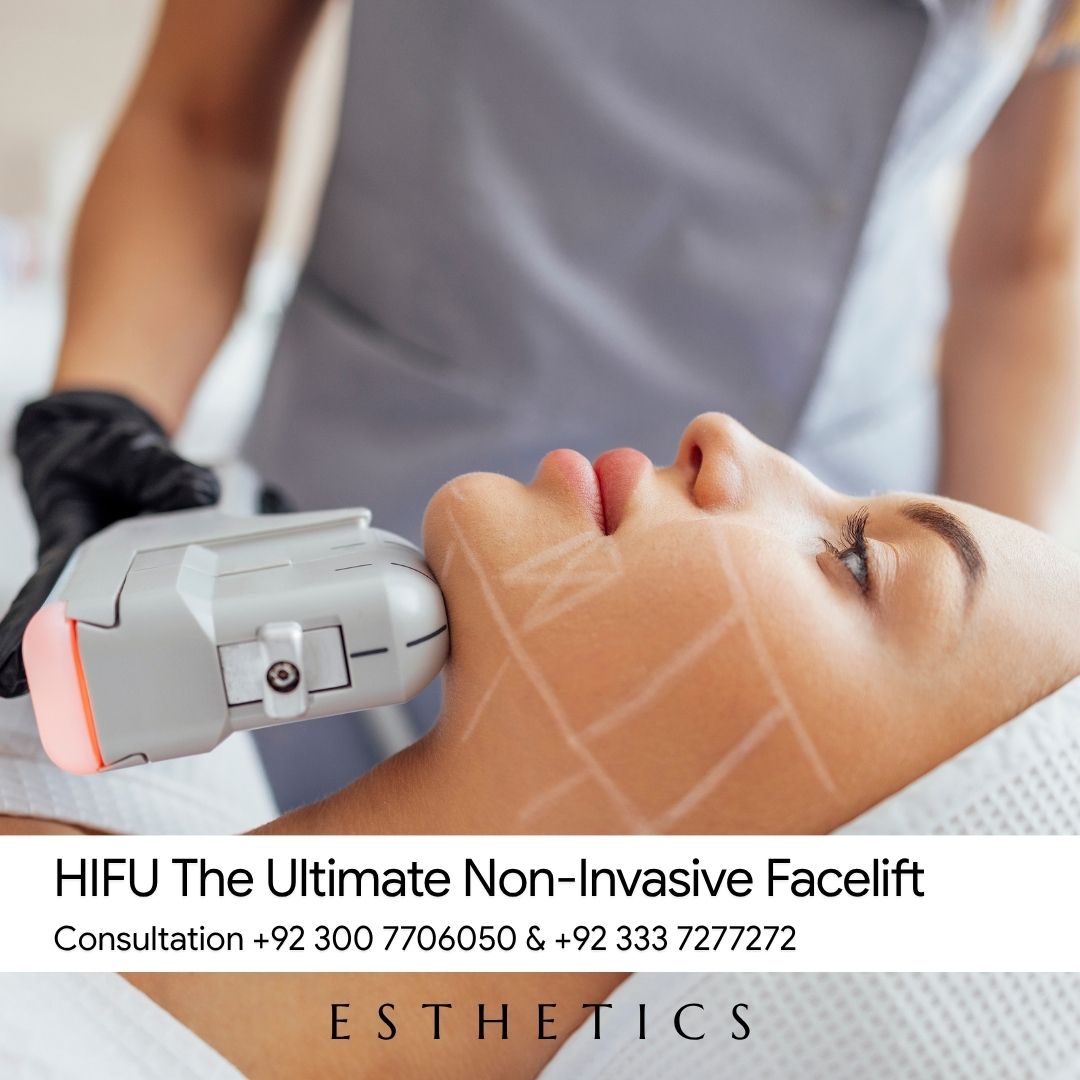
HIFU treatment, or High-Intensity Focused Ultrasound, has become a popular non-invasive aesthetic treatment for people looking to improve skin laxity, facial contours and signs of aging without undergoing traditional facelift surgery.
Unlike a surgical facelift, HIFU does not involve incisions, stitches or surgical removal of skin. Instead, focused ultrasound energy is delivered to selected tissue depths to create controlled thermal effects that stimulate tissue remodeling and collagen-related changes.
Clinical research supports the use of focused ultrasound for improvement of mild to moderate facial skin laxity and rejuvenation, although results vary according to the individual, treatment protocol, device and degree of skin laxity. Systematic reviews have reported improvements particularly in the lower face, jawline, neck and brow regions.
HIFU is therefore often described as a non-surgical or non-invasive facelift alternative. However, it is important to understand that HIFU does not reproduce the same degree of lifting or tissue repositioning as a surgical facelift.
For patients who want a gradual, natural-looking improvement without surgery or significant downtime, HIFU may be an option worth discussing with an experienced aesthetic doctor.
What Is HIFU?
HIFU stands for High-Intensity Focused Ultrasound.
It is an energy-based aesthetic technology that uses focused ultrasound energy to target selected depths beneath the surface of the skin.
Unlike treatments that primarily work at the surface, focused ultrasound can deliver energy to deeper tissue layers without intentionally damaging the skin’s outer surface.
The FDA classifies focused ultrasound stimulators for aesthetic use as Class II medical devices, with the generic device category intended to produce localized effects in tissue for non-invasive aesthetic purposes.
Different HIFU and microfocused ultrasound systems can have different designs, energy levels, treatment depths and regulatory indications.
Therefore, HIFU is not one single standardized machine or treatment protocol.
How Does HIFU Work?
HIFU uses concentrated ultrasound energy to create controlled thermal effects at selected depths within tissue.
The treatment can stimulate a wound-healing response and collagen remodeling.
Over time, this may contribute to:
- Improved skin firmness
- Better definition
- Reduction in the appearance of mild laxity
- Improved facial contours
- Gradual skin tightening
- Improvement in selected lines and wrinkles
The process is different from a surgical facelift.
A facelift physically repositions and removes selected tissues, while HIFU relies on controlled energy delivery and the body’s subsequent tissue-remodeling response.
Research reviews have found evidence of facial tightening and rejuvenation after microfocused ultrasound treatment, although the degree of improvement varies.
Why Is HIFU Called a Non-Invasive Facelift?
The term “non-invasive facelift” is commonly used in aesthetic medicine because HIFU can produce a lifting and tightening effect without traditional surgery.
However, the phrase should be understood carefully.
HIFU does not:
- Remove excess skin like surgery
- Physically reposition facial muscles like a surgical facelift
- Produce the same degree of correction as a facelift
- Permanently stop the aging process
Instead, it may provide a gradual improvement in skin tightness and facial contour.
For patients with mild to moderate laxity who are not ready for surgery, this distinction can make HIFU an attractive treatment option.
HIFU vs Surgical Facelift
HIFU and facelift surgery are fundamentally different treatments.
| Feature | HIFU | Surgical Facelift |
|---|---|---|
| Incisions | No | Yes |
| Surgery | No | Yes |
| Sutures | Usually no | Usually required |
| Anesthesia | Usually not general anesthesia | Depends on procedure |
| Downtime | Generally minimal | Significant recovery |
| Skin removal | No | May be performed |
| Tissue repositioning | No surgical repositioning | Yes |
| Results | Gradual and generally more modest | More substantial |
| Natural collagen remodeling | Yes | Healing/remodeling also occurs |
| Suitable for severe laxity | Usually limited | Can be considered |
HIFU should therefore be considered an alternative for selected patients, not a direct replacement for every facelift.
Who Is a Good Candidate for HIFU?
HIFU may be considered for adults with mild to moderate skin laxity who want improvement without surgery.
Potential candidates may have:
- Mild jawline laxity
- Early jowling
- Mild neck laxity
- Loss of facial firmness
- Early signs of aging
- Mild brow drooping
- Fine lines and wrinkles
- Reduced definition around the lower face
A systematic review of microfocused ultrasound found that treatment can be effective for mild to moderate facial skin laxity, while excessive laxity was associated with reduced results.
The best way to determine suitability is through an individual assessment.
Who May Not Be an Ideal Candidate?
HIFU is not appropriate for everyone.
Results may be limited when a person has:
- Significant excess skin
- Advanced facial sagging
- Very severe jowling
- Substantial tissue descent
- Certain active skin conditions
- Certain medical conditions affecting treatment
- Expectations of a surgical-level facelift
A 2023 systematic review noted that excessive skin laxity and higher BMI were associated with reduced treatment response in the reviewed literature.
In patients with significant excess skin, surgery may provide a more appropriate correction.
HIFU for Facial Skin Tightening
One of the most common uses of HIFU is facial skin tightening.
As we age, changes occur in:
- Collagen
- Elastin
- Skin thickness
- Fat compartments
- Ligaments
- Soft-tissue support
- Bone structure
These changes can contribute to facial laxity.
HIFU is designed to stimulate controlled tissue effects that can encourage remodeling.
The result is generally gradual rather than immediate.
HIFU for Jawline Definition
HIFU is frequently used around the lower face and jawline.
Patients may seek treatment for:
- Mildly blurred jawline
- Early jowling
- Lower-face laxity
- Reduced facial definition
By improving skin firmness, HIFU may help create a more defined appearance.
However, jawline definition depends on more than skin.
Factors such as:
- Bone structure
- Fat distribution
- Muscle
- Skin elasticity
- Genetics
- Age
also influence facial contour.
Therefore, HIFU should not be presented as a guaranteed jawline-sculpting procedure.
HIFU for Double Chin and Submental Laxity
The area beneath the chin is another commonly treated region.
HIFU may be used to address selected cases of:
- Mild submental skin laxity
- Loose skin beneath the chin
- Reduced jawline definition
Some focused-ultrasound systems have specific regulatory indications involving lax submental and neck tissue. For example, the FDA-cleared Ulthera System has indications including lifting lax submental and neck tissue.
However, not every HIFU machine has the same indication.
The device being used matters.
HIFU for Neck Tightening
Neck skin can become increasingly lax with age.
HIFU may be considered for selected patients who have:
- Mild neck laxity
- Fine lines
- Reduced firmness
- Early signs of aging
The aim is generally to improve skin firmness rather than completely eliminate severe excess skin.
Patients with significant loose skin may need a different treatment approach.
HIFU for Brow Lifting
Certain focused-ultrasound devices are used for eyebrow lifting.
The FDA’s current indication for the Ulthera System includes non-invasive eyebrow lifting.
A subtle brow elevation can sometimes create a more refreshed appearance.
However, results vary and should not be compared directly with surgical brow-lift procedures.
HIFU for Fine Lines and Wrinkles
HIFU and microfocused ultrasound may improve selected facial lines and wrinkles by improving tissue firmness and remodeling.
Research has reported improvements in facial rejuvenation and wrinkle appearance after focused ultrasound treatment.
However, HIFU is not primarily a surface-resurfacing treatment.
Patients with significant pigmentation, acne scars or surface texture concerns may require other treatments.
A combination treatment plan may sometimes be considered after professional assessment.
HIFU and Collagen
Collagen is an important structural protein in the skin.
It contributes to:
- Firmness
- Structure
- Elasticity
- Skin support
As people age, collagen production and organization change.
HIFU creates controlled energy delivery within targeted tissue layers, which can stimulate remodeling processes.
This is one reason results may develop gradually rather than immediately.
The skin’s remodeling process takes time.
When Do HIFU Results Appear?
Some patients may notice an initial improvement shortly after treatment, but the more meaningful changes generally develop progressively.
Collagen remodeling occurs over time.
Research on microfocused ultrasound has reported improvements at approximately 90 days and continuing improvement in some measures at later follow-up.
Individual results vary considerably.
The final outcome depends on:
- Age
- Skin quality
- Degree of laxity
- Treatment area
- Device
- Energy settings
- Number of treatment lines
- Treatment technique
- Lifestyle
- Individual healing response
How Long Do HIFU Results Last?
HIFU results are not permanent.
The skin continues to age after treatment.
The longevity of results depends on:
- Age
- Sun exposure
- Smoking
- Skin quality
- Lifestyle
- Genetics
- Degree of aging
- Treatment protocol
Some clinical studies report improvements lasting several months or longer, but long-term evidence and treatment protocols vary. Systematic reviews have also highlighted the need for better standardization and longer-term research.
A doctor can advise whether maintenance treatment may be appropriate.
Is HIFU Painful?
HIFU is generally considered a tolerable treatment, but some patients experience discomfort during energy delivery.
Sensations may include:
- Heat
- Tingling
- Pressure
- Pricking
- Brief sharp sensations
- Deep warmth
A 2023 meta-analysis reported an overall pain score of approximately 3.1 on a 10-point scale for microfocused ultrasound treatment.
Pain tolerance varies significantly between individuals.
Treatment settings and device technology can also influence comfort.
HIFU Side Effects
HIFU is generally associated with temporary side effects in appropriately performed treatments.
Possible short-term effects include:
- Redness
- Swelling
- Tenderness
- Temporary sensitivity
- Mild discomfort
A systematic review published in 2025 reported a generally favorable safety profile, with transient redness, swelling or mild discomfort reported in a small proportion of patients across the included studies.
Another systematic review found that more unusual adverse effects were uncommon but could include temporary sensory changes, bruising and other treatment-related effects.
Can HIFU Cause Burns?
HIFU uses concentrated energy and therefore requires appropriate device settings and professional technique.
Improper energy delivery can cause unwanted tissue injury.
Possible complications reported in the literature can include:
- Burns
- Pain
- Temporary numbness
- Sensory changes
- Swelling
- Bruising
- Surface marks
This is why HIFU should be performed using an appropriate device by a properly trained professional.
Is HIFU Safe?
HIFU can have a favorable safety profile when an appropriate device is used correctly and patients are appropriately selected.
However, non-invasive does not mean risk-free.
Safety depends on:
- Device quality
- Treatment settings
- Operator training
- Treatment depth
- Patient anatomy
- Appropriate patient selection
- Proper technique
The FDA classifies focused ultrasound aesthetic systems under a specific Class II device category with special controls.
Patients should ask what device is being used and whether it is appropriate for the intended treatment.
Why Device Quality Matters
The word “HIFU” describes a technology, not a single machine.
Different devices can vary in:
- Energy delivery
- Treatment depth
- Transducer design
- Visualization capabilities
- Treatment indications
- Regulatory status
- Clinical evidence
For example, the FDA-cleared Ulthera System uses DeepSEE ultrasound visualization to visualize tissue depths up to 8 mm for treatment planning and has specific aesthetic indications.
Therefore, patients should not assume that every device marketed as HIFU has identical performance.
HIFU With Visualization
Some advanced microfocused ultrasound systems incorporate ultrasound visualization.
Visualization can allow the practitioner to see selected tissue layers before delivering energy.
This can potentially improve treatment planning and precision.
A 2025 systematic review and meta-analysis specifically evaluated microfocused ultrasound with visualization (MFU-V) for facial rejuvenation and tightening.
Whether visualization is available depends on the device.
HIFU vs RF Skin Tightening
Both HIFU and radiofrequency (RF) can be used for skin tightening, but they use different forms of energy.
HIFU
Uses focused ultrasound energy.
RF
Uses radiofrequency energy to produce controlled heating within targeted tissues.
Neither treatment is automatically better for every patient.
The appropriate technology depends on:
- Skin laxity
- Treatment area
- Skin thickness
- Patient goals
- Device
- Practitioner experience
A professional assessment can help determine which approach is appropriate.
HIFU vs Laser Skin Rejuvenation
HIFU and laser treatments also work differently.
HIFU primarily targets deeper tissues for tightening and remodeling.
Laser treatments can target different skin layers and may be used for:
- Pigmentation
- Texture
- Fine lines
- Scars
- Vascular concerns
- Resurfacing
A patient with both laxity and surface skin concerns may require a different or combination treatment plan.
HIFU vs Dermal Fillers
HIFU and dermal fillers address different concerns.
HIFU aims primarily to improve skin firmness and tissue laxity.
Dermal fillers are injectable products used to add or restore volume in selected areas.
For some patients, a combination approach may be considered.
However, combining treatments should be based on facial anatomy and treatment goals rather than automatically performing multiple procedures.
HIFU vs Botox
HIFU and botulinum toxin have completely different mechanisms.
HIFU uses focused ultrasound energy.
Botulinum toxin temporarily reduces activity of selected muscles.
HIFU is generally used for concerns involving laxity and tightening, while botulinum toxin is commonly used for dynamic facial lines and selected muscle-related concerns.
The two treatments are therefore not direct substitutes.
HIFU for Men
HIFU is not limited to women.
Men may seek treatment for:
- Jawline definition
- Mild facial laxity
- Neck laxity
- Early signs of aging
- Fine lines
- Skin firmness
The same principle applies: treatment should be customized according to male facial anatomy and individual goals.
HIFU for Different Skin Types
HIFU works differently from treatments that rely primarily on chromophores in the skin.
Because ultrasound energy is not primarily targeting melanin, it may be considered across a broad range of skin types.
However, appropriate patient assessment remains important.
The practitioner should consider:
- Skin thickness
- Fat distribution
- Facial anatomy
- Degree of laxity
- Previous procedures
- Medical history
Research also emphasizes the importance of further study across diverse skin types and standardized treatment protocols.
HIFU in Pakistan
HIFU treatment in Pakistan is increasingly popular among people looking for non-surgical facial tightening and rejuvenation.
Patients may search for:
- HIFU treatment Pakistan
- HIFU facial Pakistan
- HIFU skin tightening Pakistan
- HIFU facelift Pakistan
- HIFU treatment Islamabad
- HIFU treatment Rawalpindi
- HIFU face lifting Pakistan
- HIFU for double chin Pakistan
- HIFU jawline tightening Pakistan
- HIFU neck tightening Pakistan
Because device quality and treatment protocols vary, patients should focus on the qualifications of the practitioner and the technology being used rather than selecting treatment solely according to price.
HIFU Treatment in Islamabad
Patients looking for HIFU treatment in Islamabad may consider it for:
- Facial tightening
- Jawline definition
- Neck tightening
- Brow lifting
- Mild facial laxity
- Skin rejuvenation
A consultation can determine whether HIFU is appropriate or whether another treatment would provide a better outcome.
At an aesthetic clinic, the practitioner may assess the face from multiple angles and determine:
- Degree of laxity
- Skin quality
- Treatment area
- Appropriate treatment depth
- Expected outcome
HIFU Treatment in Rawalpindi
People searching for HIFU treatment in Rawalpindi may have similar concerns involving facial or neck laxity.
The same principles apply.
Treatment should be individualized rather than based on a fixed number of ultrasound lines or a generic package.
The number of treatment areas and energy delivery should depend on the patient’s anatomy and treatment plan.
Is HIFU a Good Alternative to a Facelift?
For some patients, yes—but with realistic expectations.
HIFU may be a good option for someone who:
- Has mild to moderate laxity
- Wants non-invasive treatment
- Does not want surgery
- Wants little downtime
- Prefers gradual improvement
A surgical facelift may be more appropriate for someone with:
- Significant excess skin
- Advanced jowling
- Severe facial laxity
- Major tissue descent
The best treatment is the one appropriate for the patient’s anatomy and goals.
Benefits of HIFU
Potential benefits include:
Non-invasive
No traditional surgical incision is required.
Minimal downtime
Most patients can return to normal activities relatively quickly.
Gradual results
The improvement can develop progressively.
Natural-looking changes
HIFU does not physically pull the face into a surgical position.
Collagen remodeling
The treatment can stimulate remodeling processes.
Multiple treatment areas
Depending on the device and indication, areas such as the face, neck and brow may be treated.
No surgical scars
Because there is no traditional incision, surgical scarring is avoided.
Limitations of HIFU
HIFU also has limitations.
It cannot:
- Remove large amounts of excess skin
- Reposition facial tissues like surgery
- Guarantee a specific degree of lifting
- Stop future aging
- Replace every surgical procedure
- Produce identical results in every patient
Patients should understand these limitations before treatment.
How Long Does a HIFU Treatment Take?
Treatment time varies according to:
- Treatment area
- Device
- Number of lines
- Facial anatomy
- Treatment protocol
A smaller area may take considerably less time than full-face and neck treatment.
The clinic should provide an estimated treatment time during consultation.
Is There Downtime After HIFU?
One advantage of HIFU is that it generally involves minimal downtime.
Some patients may experience temporary:
- Redness
- Swelling
- Tenderness
- Sensitivity
Most patients can generally resume normal activities relatively quickly, although individual recovery varies.
The practitioner should provide post-treatment instructions.
HIFU Before and After
Patients searching for HIFU before and after photographs should understand that results can vary significantly.
Factors affecting results include:
- Age
- Skin laxity
- Facial structure
- Skin quality
- Device
- Treatment settings
- Number of treatment lines
- Practitioner technique
- Follow-up period
Before-and-after photographs should therefore be viewed as examples rather than guarantees.
How Many HIFU Sessions Are Needed?
The number of treatments varies.
Some patients may undergo a single treatment session followed by reassessment.
Others may be advised to consider maintenance treatment later.
The appropriate schedule depends on:
- Degree of laxity
- Treatment goals
- Device
- Energy settings
- Individual response
A practitioner should determine the treatment plan after assessing the patient’s face.
Can HIFU Melt Facial Fat?
This is an important issue.
HIFU is sometimes marketed online as a fat-burning or face-slimming treatment.
However, treatment effects depend heavily on the device, energy parameters and anatomical target.
Inappropriately aggressive treatment in areas with limited facial fat could potentially create an undesirable appearance.
For facial treatment, the goal is often tightening and lifting, not indiscriminate fat reduction.
This is another reason why individualized treatment planning is important.
HIFU for Facial Contouring
Facial contouring can involve multiple structures.
HIFU may improve the appearance of a less-defined jawline when skin laxity is contributing to the problem.
However, it cannot change:
- Bone structure
- Genetic facial proportions
- Major fat deposits in every case
- Severe excess skin
For some patients, another treatment may be more appropriate.
HIFU and Natural-Looking Results
One reason people choose HIFU is that the changes generally develop gradually.
Rather than physically pulling the skin into a new position, the treatment relies on tissue response and remodeling.
This can make the outcome appear subtle and progressive.
However, “natural-looking” does not mean “guaranteed.”
Individual responses differ.
What Should You Expect During a HIFU Consultation?
A proper consultation may include:
Facial assessment
The practitioner examines skin laxity and facial anatomy.
Treatment goals
You explain what you want to improve.
Medical history
Relevant medical information and previous procedures are discussed.
Treatment planning
The practitioner identifies suitable treatment areas.
Device discussion
You should be able to ask what device will be used.
Expected results
The practitioner should explain realistic outcomes.
Risks
Potential side effects and complications should be discussed.
Follow-up
You should understand when results will be evaluated.
Questions to Ask Before HIFU Treatment
Before booking HIFU, consider asking:
- What HIFU device do you use?
- What is the manufacturer’s intended use?
- Is the device appropriate for my treatment area?
- Who will perform the treatment?
- What qualifications and training does the practitioner have?
- How many treatment areas do I need?
- What results are realistic?
- What are the potential side effects?
- How long will results last?
- Do I need maintenance treatment?
These questions can help you make a more informed decision.
Is HIFU Suitable for Everyone?
No.
A consultation is necessary because treatment suitability depends on individual anatomy and medical circumstances.
A practitioner may recommend another option if:
- Skin laxity is too advanced
- There is excessive skin
- Another medical condition needs attention
- The patient’s expectations are unrealistic
- Another treatment is more appropriate
Good aesthetic medicine is not about performing the procedure requested at any cost.
It is about selecting an appropriate treatment for the individual.
HIFU and Combination Treatments
HIFU can sometimes form part of a broader aesthetic treatment plan.
Depending on the patient’s needs, other treatments may address:
- Skin texture
- Pigmentation
- Fine lines
- Facial volume
- Muscle-related lines
- Hydration
Combination treatments should be planned carefully.
More treatments do not automatically mean better results.
Why Professional HIFU Treatment Matters
HIFU involves delivering concentrated energy to specific tissue depths.
Incorrect treatment parameters can potentially cause unwanted effects.
Professional treatment should involve:
- Appropriate patient assessment
- Knowledge of facial anatomy
- Appropriate device selection
- Correct treatment depth
- Appropriate energy settings
- Proper technique
- Post-treatment guidance
Patients should be cautious of extremely cheap treatments where the device, practitioner or treatment protocol is unclear.
HIFU: The Ultimate Non-Invasive Facelift?
HIFU can reasonably be described as one of the leading non-invasive skin-tightening technologies, particularly for patients with mild to moderate facial laxity.
Clinical evidence supports its potential for facial tightening and rejuvenation, but the results are generally more modest than surgical facelift surgery. Systematic reviews have found measurable improvement in facial skin tightening, particularly in selected patients.
Therefore, the phrase “ultimate non-invasive facelift” is best understood as a descriptive marketing phrase—not a claim that HIFU is superior to every other treatment or equivalent to surgery.
The right treatment depends on the patient.
Frequently Asked Questions About HIFU
What is HIFU?
HIFU stands for High-Intensity Focused Ultrasound. It is an energy-based technology used for selected non-invasive aesthetic treatments.
Is HIFU really a facelift?
HIFU is not a surgical facelift. It is a non-invasive treatment that may improve skin tightening and selected facial laxity.
Does HIFU tighten skin?
Yes, HIFU and microfocused ultrasound can improve skin tightening in appropriately selected patients.
Is HIFU painful?
Some patients experience discomfort, heat, tingling or brief sharp sensations. Pain varies between individuals and devices.
How long do HIFU results take?
Results generally develop gradually as tissue remodeling occurs. Clinical studies have assessed outcomes at several months following treatment.
How long do HIFU results last?
Results vary. Some studies report improvements lasting several months or longer, but long-term outcomes vary by device, protocol and patient.
Does HIFU have downtime?
HIFU generally has minimal downtime, although temporary redness, swelling or tenderness can occur.
Can HIFU remove sagging skin?
HIFU can improve selected mild to moderate laxity, but it does not remove large amounts of excess skin.
Is HIFU better than a facelift?
No treatment is universally better. HIFU is non-invasive and generally produces more modest results, while surgery can provide greater tissue repositioning and correction of excess skin.
Can HIFU treat the jawline?
HIFU may improve jawline appearance when mild skin laxity is a contributing factor.
Can HIFU treat the neck?
Yes, selected HIFU systems and treatment protocols are used for neck and submental laxity.
Can HIFU lift the eyebrows?
Certain focused-ultrasound systems have specific indications for non-invasive eyebrow lifting.
Is HIFU safe?
HIFU can have a favorable safety profile when properly performed, but it is not completely risk-free.
How many HIFU sessions do I need?
The number varies according to the patient, treatment area, device and goals.
Can men get HIFU?
Yes. HIFU can be used for appropriate male patients.
Is HIFU suitable for older skin?
It may be useful for selected patients with mild to moderate laxity. Advanced laxity may require another treatment.
HIFU Treatment in Pakistan – Specialist Consultation
If you are considering HIFU treatment in Pakistan for facial tightening, jawline definition, neck tightening, brow lifting or skin rejuvenation, the best first step is a professional consultation.
A qualified aesthetic practitioner can evaluate:
- Your skin laxity
- Facial anatomy
- Skin quality
- Treatment goals
- Previous aesthetic procedures
- Suitable treatment areas
- Expected results
- Potential risks
The consultation also provides an opportunity to determine whether HIFU is actually the best treatment for you.
Final Takeaway
HIFU – the ultimate non-invasive facelift is a popular approach to facial tightening because it can deliver focused ultrasound energy without traditional surgery or incisions.
Evidence from systematic reviews supports the use of focused and microfocused ultrasound for selected patients with mild to moderate facial laxity, with improvements reported in areas including the lower face, submental region, neck and brow.
However, HIFU is not equivalent to a surgical facelift.
It does not remove excess skin or physically reposition facial tissues in the same way as surgery. The best candidates are generally those seeking gradual improvement in mild to moderate laxity and who prefer a non-invasive approach.
Results depend on:
- Patient anatomy
- Degree of laxity
- Device
- Treatment depth
- Energy settings
- Practitioner expertise
- Individual healing response
For safe and appropriate treatment, patients should choose a qualified practitioner and ask about the specific HIFU technology being used.
Considering HIFU Treatment?
If you are interested in HIFU skin tightening, HIFU facelift, HIFU facial rejuvenation, HIFU jawline tightening or HIFU neck tightening in Pakistan, arrange a professional consultation to determine whether the treatment is appropriate for your skin and facial anatomy.