
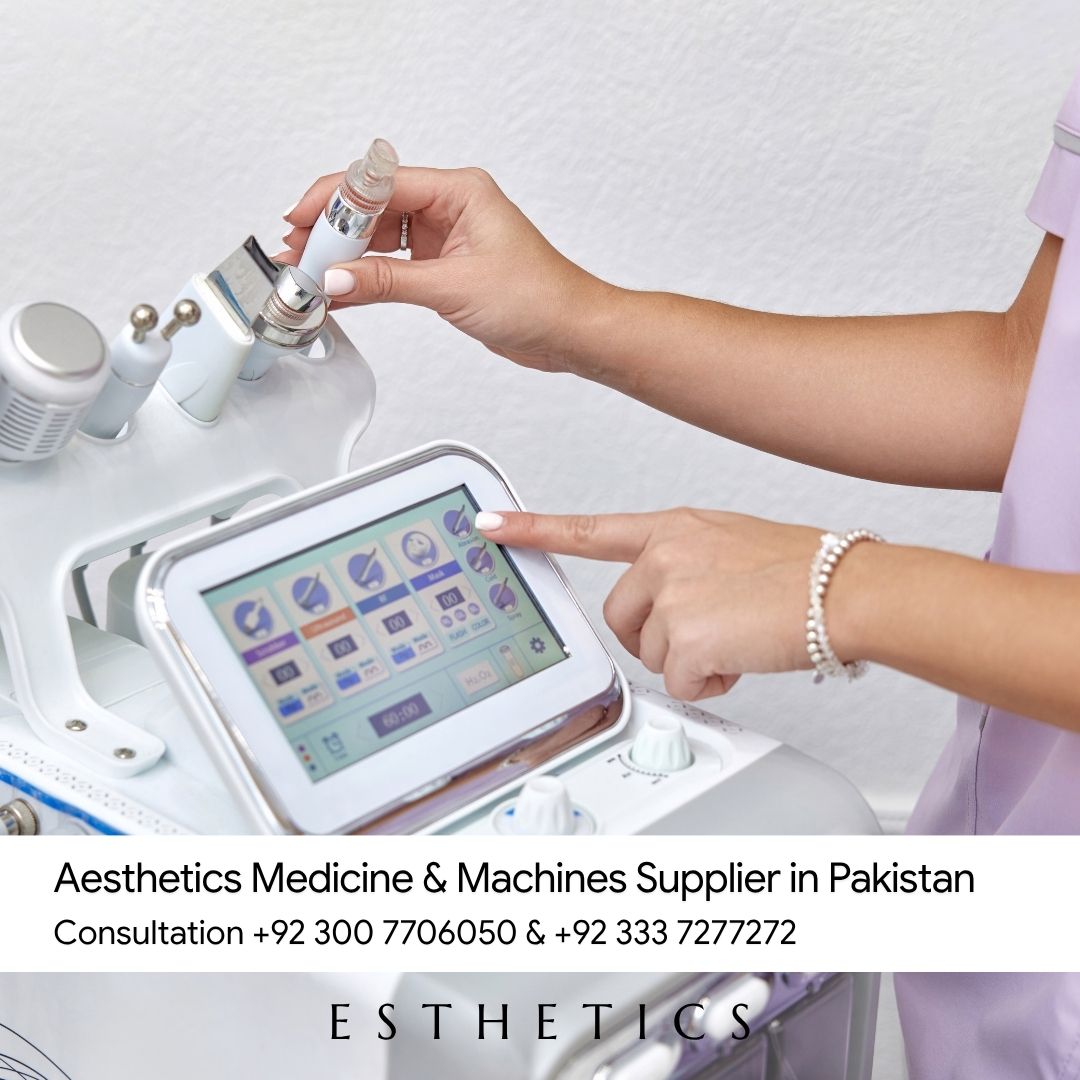
The demand for aesthetic medicine and aesthetic machines in Pakistan is growing as dermatology clinics, aesthetic centers, plastic surgery practices, medical spas and cosmetic clinics expand their treatment services.
Modern aesthetic practices require much more than a laser machine. Clinics may need a complete ecosystem of injectable aesthetic products, skin-care solutions, medical consumables, laser systems, facial machines, body-contouring equipment, HIFU, RF microneedling, CO₂ lasers and other professional technologies.
Choosing the right aesthetics medicine and machines supplier in Pakistan is therefore an important business and clinical decision. A reliable supplier should be able to provide genuine products, appropriate documentation, equipment training, installation, technical support, spare parts and dependable after-sales service.
For medicines and therapeutic products, regulatory compliance is particularly important. In Pakistan, the Drug Regulatory Authority of Pakistan (DRAP) regulates therapeutic goods including pharmaceutical and biological drugs, medical devices and medical cosmetics, and oversees areas such as registration, licensing, market surveillance, quality and safety.
This comprehensive guide explains the major categories of aesthetic medicines, aesthetic machines and professional clinic equipment available in Pakistan, what clinics should consider before purchasing, and how to select a reliable supplier.
What Is an Aesthetics Medicine & Machines Supplier?
An aesthetics medicine and machines supplier provides professional products and equipment used by qualified healthcare professionals and aesthetic practices.
The supply category can include:
Aesthetic medicines and injectable products
- Dermal fillers
- Botulinum toxin products
- Skin boosters
- Biostimulators
- Polynucleotides
- Mesotherapy products
- Selected injectable lipolysis products
- Professional skincare products
- Other aesthetic consumables
Aesthetic machines
- Diode laser
- Alexandrite laser
- Nd:YAG laser
- Q-switched laser
- CO₂ fractional laser
- IPL
- HIFU
- RF
- RF microneedling
- HydraFacial systems
- Body-contouring equipment
- Skin analyzers
- Facial treatment machines
Clinic supplies
- Needles
- Syringes
- Cartridges
- Treatment tips
- Handpieces
- Consumables
- Protective equipment
- Replacement parts
The exact products available should depend on their regulatory status, intended professional use and applicable Pakistani requirements.
Aesthetic Medicine Supplier in Pakistan
The term aesthetic medicine supplier in Pakistan covers suppliers serving professionals who perform cosmetic and dermatological procedures.
Clinics may need products for:
- Facial rejuvenation
- Wrinkle management
- Volume restoration
- Skin hydration
- Skin quality
- Pigmentation
- Hair restoration
- Body contouring
- Facial treatments
- Regenerative aesthetic procedures
However, aesthetic medicines are not ordinary beauty products.
Many injectable or therapeutic products fall under regulated categories, and DRAP states that therapeutic goods must meet prescribed standards relating to quality, safety and efficacy.
Therefore, clinics should verify the product’s:
- Manufacturer
- Active ingredient
- Batch information
- Expiry date
- Storage requirements
- Regulatory status
- Import/distribution documentation
- Authenticity
Aesthetic Machine Supplier in Pakistan
A professional aesthetic machine supplier in Pakistan may supply equipment to:
- Dermatologists
- Plastic surgeons
- Aesthetic physicians
- Medical clinics
- Aesthetic centers
- Med spas
- Hospitals
- Professional skin clinics
The right machine depends on the treatment services the clinic intends to offer.
For example:
| Treatment | Common Equipment Category |
|---|---|
| Laser hair reduction | Diode / Alexandrite / Nd:YAG |
| Pigmentation | Q-switched / selected laser or IPL systems |
| Skin resurfacing | Fractional CO₂ / fractional laser |
| Skin tightening | HIFU / RF |
| Acne scars | Fractional laser / RF microneedling |
| Facial cleansing | HydraFacial / hydrodermabrasion |
| Body contouring | RF / ultrasound / cooling / other systems |
| Skin analysis | Digital skin analyzer |
| Microneedling | Microneedling / RF microneedling |
The correct device depends on its specifications, intended indication, operator qualifications and patient population.
Why Clinics Need a Professional Supplier
Buying aesthetic equipment or injectable products from an unknown source can create unnecessary risks.
A professional supplier should help the clinic with:
Product selection → Documentation → Delivery → Installation → Training → Maintenance → Spare parts → Technical support
For machines, after-sales support can be particularly important.
Aesthedoc’s published supplier information, for example, describes aesthetic machines, spare parts, handpieces, training, maintenance and nationwide delivery/support.
For therapeutic products, regulatory compliance is equally important. DRAP publishes requirements and guidance covering pharmaceuticals, medical devices, therapeutic goods, import/export, quality assurance, good distribution practices and advertising.
Aesthetic Medicines Available for Professional Clinics
The aesthetic medicine market includes several major product categories.
1. Dermal Fillers
Dermal fillers are injectable products used to restore or add volume in selected facial areas.
Depending on the product, fillers may be used for:
- Lips
- Cheeks
- Chin
- Jawline
- Nasolabial folds
- Facial contouring
- Selected scars
- Other indications
Hyaluronic acid is one of the most widely used filler materials.
Different fillers have different:
- Concentrations
- Particle characteristics
- Cross-linking
- Elasticity
- Viscosity
- Intended applications
A clinic should select a filler according to the patient’s anatomy and the manufacturer’s intended use.
2. Skin Boosters
Skin boosters are injectable products designed primarily to improve selected aspects of skin quality rather than create significant structural facial volume.
Depending on the formulation, they may be used for:
- Hydration
- Skin texture
- Fine lines
- Skin quality
- Radiance
Products differ significantly, so clinics should verify the exact composition and intended indication.
3. Polynucleotides
Polynucleotide-based aesthetic products have become increasingly prominent in aesthetic medicine.
They are marketed for skin-quality and regenerative aesthetic applications.
Potential treatment goals may include:
- Skin texture
- Hydration
- Fine lines
- Skin quality
- Overall rejuvenation
However, product composition, regulatory status and evidence can vary.
Clinics should avoid treating every polynucleotide product as interchangeable.
4. Biostimulators
Biostimulatory aesthetic products are designed to stimulate a biological response that can contribute to collagen remodeling.
Examples of materials used in aesthetic medicine include:
- PLLA
- Calcium hydroxylapatite
- Other biostimulatory formulations
These products are different from traditional volumizing fillers and should be selected according to the intended indication.
5. Mesotherapy Products
Mesotherapy involves delivering selected substances through multiple superficial injections.
Depending on the treatment protocol, products may be marketed for:
- Skin rejuvenation
- Hydration
- Hair-related applications
- Pigmentation
- Other aesthetic concerns
Because formulations vary considerably, the exact ingredients and professional indication should always be verified.
6. Hair Restoration Products
Aesthetic clinics may also require professional products used alongside hair-restoration procedures.
Potential categories include:
- Mesotherapy products
- Polynucleotides
- Growth-factor-related products
- PRP-related consumables
- Post-procedure skincare
- Hair-care products
Treatment should be based on appropriate diagnosis rather than simply injecting a product because it is marketed for hair growth.
7. Fat-Reduction Injectable Products
Some aesthetic practices offer injectable lipolysis for selected localized fat deposits.
Products marketed internationally in this category can have substantially different formulations and regulatory statuses.
For example, the U.S. FDA has approved deoxycholic acid for adult submental fat, while warning consumers about unapproved fat-dissolving injectable products marketed under various names.
Therefore, clinics should verify:
- Active ingredient
- Manufacturer
- Regulatory status
- Treatment indication
- Storage
- Authenticity
before purchasing injectable fat-reduction products.
8. Professional Skincare
Aesthetic clinics may also stock professional skincare products such as:
- Cleansers
- Chemical exfoliants
- Pigmentation products
- Retinoid-based products
- Sunscreens
- Post-procedure creams
- Barrier-repair products
- Professional masks
These products can complement aesthetic procedures and support patients’ home-care routines.
Aesthetic Machines Categories
A complete aesthetic equipment supplier may offer several categories of machines.
Diode Laser Hair Removal Machines
Diode laser systems are among the most popular machines for aesthetic clinics.
They are primarily used for long-term hair reduction.
Depending on the system, diode platforms can use different wavelengths and configurations.
Commonly encountered wavelengths include:
- 755 nm
- 808/810 nm
- 940 nm
- 1064 nm
Some modern platforms combine multiple wavelengths.
When comparing diode machines, clinics should look beyond the marketing name and compare:
- Wavelength
- Energy output
- Pulse duration
- Spot size
- Cooling
- Repetition rate
- Handpiece
- Treatment modes
- Warranty
- Service support
Alexandrite Laser
Alexandrite lasers generally use a 755 nm wavelength.
They can be used for selected:
- Hair-reduction procedures
- Pigment-related applications
- Other dermatological indications depending on the specific device
Alexandrite technology can be particularly useful for appropriate patient and hair/skin combinations.
Nd:YAG Laser
Nd:YAG systems commonly operate at 1064 nm.
They can have applications including selected:
- Hair reduction
- Pigmentation treatments
- Vascular treatments
- Dermatological procedures
Because the 1064 nm wavelength penetrates relatively deeply, appropriate treatment parameters and patient selection are important.
Q-Switched Nd:YAG
Q-switched Nd:YAG systems are widely used in aesthetic dermatology for selected pigmentation and tattoo-related applications.
Potential applications can include:
- Tattoos
- Certain pigmented lesions
- Selected pigmentation procedures
- Certain skin-rejuvenation protocols
However, pigmentation should be diagnosed before laser treatment.
Fractional CO₂ Laser
Fractional CO₂ laser is an advanced resurfacing technology.
It may be used for selected concerns such as:
- Acne scars
- Fine lines
- Wrinkles
- Uneven texture
- Photodamage
- Certain scars
Fractional CO₂ can be a relatively intensive treatment and requires proper operator training.
The machine itself is only one part of safe treatment. The operator must understand:
- Energy settings
- Density
- Treatment depth
- Skin type
- Contraindications
- Infection prevention
- Post-treatment care
IPL Machines
Intense Pulsed Light (IPL) is different from a laser.
IPL uses a broad spectrum of light and can be used for selected:
- Pigmentation concerns
- Vascular concerns
- Photorejuvenation
- Hair reduction
- Acne-related applications
The exact indication depends on the machine and its filters.
HIFU Machines
High-Intensity Focused Ultrasound (HIFU) is used in aesthetic medicine for selected skin-tightening and tissue-remodeling applications.
Depending on the machine, HIFU may be marketed for:
- Facial tightening
- Jawline contouring
- Neck treatment
- Body contouring
Different HIFU platforms can vary considerably in:
- Treatment depth
- Cartridge configuration
- Energy delivery
- Treatment area
- Safety systems
Therefore, clinics should compare actual specifications.
RF Microneedling Machines
RF microneedling combines controlled microneedling with radiofrequency energy.
Potential applications include:
- Acne scars
- Skin texture
- Fine lines
- Skin tightening
- Pore appearance
- Collagen remodeling
The treatment is more advanced than conventional microneedling because RF energy is delivered into selected tissue depths.
HydraFacial & Hydrodermabrasion Machines
HydraFacial-style and hydrodermabrasion machines are popular in aesthetic clinics.
Depending on the system, they may offer:
- Cleansing
- Exfoliation
- Extraction
- Hydration
- Serum application
- Vacuum-assisted treatment
A clinic should distinguish between an official branded system and generic hydrodermabrasion equipment.
Body Contouring Machines
Body-contouring machines may use:
- RF
- Ultrasound
- Controlled cooling
- Vacuum
- Electromagnetic energy
- Other technologies
Potential applications include:
- Localized contouring
- Skin tightening
- Cellulite appearance
- Fat reduction
- Muscle stimulation
The evidence and appropriate indications vary by technology.
Skin Analyzer Machines
A digital skin analyzer can help clinics assess and document aspects of skin condition.
Depending on the platform, it may visualize:
- Pigmentation
- UV damage
- Pores
- Texture
- Wrinkles
- Sebum
These systems can be particularly useful for consultation and patient education.
They should not, however, be considered a replacement for medical examination.
Aesthetic Machine Price in Pakistan
The aesthetic machine price in Pakistan varies widely.
There is no single price for an “aesthetic machine.”
The price depends on:
- Technology
- Manufacturer
- Model
- Country of manufacture
- New or refurbished condition
- Specifications
- Handpieces
- Applicators
- Warranty
- Installation
- Training
- Import costs
- Spare parts
- After-sales service
Two machines marketed for the same treatment can therefore have dramatically different prices.
Aesthetic Medicine Price in Pakistan
Similarly, the cost of aesthetic medicines depends on the exact product.
Factors include:
- Brand
- Manufacturer
- Active ingredient
- Packaging
- Dosage/concentration
- Regulatory status
- Import/distribution costs
- Storage requirements
- Availability
Clinics should not compare products based solely on the number of syringes or boxes.
The formulation and intended indication matter.
Why Authenticity Matters
Counterfeit or improperly stored products can create serious risks.
A professional supplier should be able to provide appropriate information regarding:
- Manufacturer
- Batch number
- Expiry
- Packaging
- Storage
- Supply chain
- Product documentation
DRAP maintains regulatory systems for therapeutic goods and provides information relating to registered products, recalls and regulatory compliance.
Cold-Chain and Storage for Aesthetic Medicines
Some injectable and biological products require controlled storage conditions.
A supplier should communicate:
- Recommended temperature
- Transportation conditions
- Storage requirements
- Expiry information
- Handling requirements
Clinics should have appropriate storage procedures after receiving products.
A machine can be inspected visually, but a medicine may be compromised even when its packaging appears normal if storage conditions have not been maintained.
Regulatory Compliance in Pakistan
This is an especially important section for any website targeting aesthetic medicine supplier Pakistan.
DRAP regulates therapeutic goods in Pakistan, including:
- Pharmaceutical and biological drugs
- Medical devices
- Medical cosmetics
- Health and OTC products
Its regulatory functions include product registration and marketing authorization, licensing, inspection, market surveillance, laboratory testing and pharmacovigilance.
DRAP also publishes specific medical-device guidance, including Good Distribution Practices of Medical Devices.
For businesses importing or distributing regulated products, the relevant registrations, licenses and permissions should be obtained before commercial supply.
Pakistan’s Single Window also provides online processing for certain DRAP-related applications, including drug sales licenses, manufacturing licenses, import licenses and release orders.
Medical Device Registration in Pakistan
Aesthetic machines can fall within medical-device regulatory frameworks depending on their nature and intended use.
DRAP’s medical-device regulatory system includes registration and licensing processes, and its current digital system provides online mechanisms for medical-device licensing and product registration.
Therefore, suppliers should be able to explain the regulatory position of the equipment they sell.
How to Choose an Aesthetic Medicine Supplier
Before purchasing aesthetic medicines, ask:
Is the product genuine?
Request appropriate documentation and verify packaging and batch information.
Who manufactured it?
Research the manufacturer.
What is the active ingredient?
Do not rely solely on a product’s marketing name.
What is the intended indication?
The same general category can contain products with very different uses.
How should it be stored?
Confirm storage and transportation requirements.
What is the expiry date?
Check before accepting the shipment.
Is it appropriately registered or authorized?
For regulated products, verify the relevant Pakistani regulatory requirements.
How to Choose an Aesthetic Machine Supplier
Before purchasing a machine, ask:
- What is the exact model?
- Who manufactures it?
- Where is it manufactured?
- Is it new or refurbished?
- What are its technical specifications?
- What treatment indications is it designed for?
- What documentation is available?
- Is installation included?
- Is training included?
- How long is the warranty?
- Are spare parts available in Pakistan?
- Who handles repairs?
- Is technical support available nationwide?
- What consumables are required?
- What is the replacement cost of handpieces and cartridges?
Why After-Sales Support Is Important
An aesthetic machine is a business investment.
If the machine stops working, a clinic may lose:
- Appointments
- Revenue
- Patient confidence
- Staff time
Therefore, after-sales service can be as important as the original machine price.
Some Pakistani suppliers advertise installation, training, maintenance and nationwide technical support as part of their equipment services.
Aesthetic Machine Installation in Pakistan
Professional installation can help ensure:
- Correct machine configuration
- Appropriate electrical setup
- Proper handpiece installation
- Operator orientation
- Safety procedures
For certain machines, room requirements may also need consideration.
These can include:
- Electrical load
- Ventilation
- Cooling
- Space
- Laser safety
- Patient positioning
- Equipment access
Aesthetic Machine Training
Training should ideally cover:
- Machine operation
- Treatment indications
- Contraindications
- Parameter selection
- Skin-type considerations
- Safety
- Cleaning
- Basic maintenance
- Emergency procedures
The supplier should provide training appropriate to the specific machine.
Buying a powerful machine without adequate operator training is not a good investment.
Spare Parts & Consumables
Before purchasing equipment, ask about:
- Handpieces
- Filters
- Tips
- Cartridges
- Cooling components
- Laser sources
- Replacement cables
- RF electrodes
- Other consumables
A machine can become expensive to operate if essential components are difficult to source.
New vs Refurbished Aesthetic Machines
New Machines
Advantages can include:
- Latest configuration
- Manufacturer warranty
- New components
- Updated software
- Current accessories
Refurbished Machines
Potential advantages include:
- Lower capital cost
- Access to established technologies
- Lower initial investment
But buyers should verify:
- Previous use
- Service history
- Component replacement
- Calibration
- Handpiece condition
- Warranty
- Spare-part availability
Aesthetic Clinic Equipment Packages
For a new clinic, purchasing machines individually may not always be the best strategy.
A supplier can potentially help design an equipment package around the clinic’s:
- Budget
- Treatment menu
- Patient demographic
- Available space
- Staff
- Expected patient volume
- Business model
A new clinic might prioritize a smaller number of high-demand technologies rather than purchasing every machine available.
Recommended Starter Aesthetic Clinic Equipment
A basic clinic setup could potentially include:
Hair Reduction
Diode laser
Facial Treatments
Hydrodermabrasion/HydraFacial system
Skin Tightening
HIFU or RF
Skin Analysis
Digital skin analyzer
Advanced Treatment
RF microneedling
A clinic can add technologies such as:
- CO₂ fractional laser
- Q-switched Nd:YAG
- IPL
- Body contouring
- Alexandrite laser
as demand grows.
The exact equipment portfolio should be determined according to the clinic’s professional services and patient needs.
Aesthetic Machines for Dermatology Clinics
Dermatology clinics may require a broader range of technologies.
A potential equipment portfolio can include:
- Diode laser
- Alexandrite
- Nd:YAG
- Q-switched laser
- Fractional CO₂
- RF microneedling
- IPL
- HIFU
- Skin analyzer
The most important factor is not how many machines a clinic owns but whether each device has a clear clinical and business purpose.
Aesthetic Machines for Plastic Surgery Clinics
Plastic surgery practices may use aesthetic equipment as a complement to surgical services.
Potential technologies include:
- Skin resurfacing lasers
- Skin-tightening devices
- Facial rejuvenation equipment
- Body-contouring systems
- Scar-treatment equipment
The equipment should complement the clinic’s surgical and non-surgical treatment portfolio.
Aesthetic Equipment for Medical Spas
Medical spas may focus on:
- Facial treatments
- Skin rejuvenation
- Hair reduction
- Body contouring
- Skin tightening
The equipment portfolio should correspond to the procedures the facility is legally and professionally equipped to provide.
Aesthetic Medicine & Machines Supplier in Islamabad
Clinics searching for an aesthetic medicine and machines supplier in Islamabad can look for suppliers that provide:
- Professional aesthetic products
- Laser machines
- HIFU
- RF
- CO₂
- HydraFacial equipment
- Body-contouring systems
- Spare parts
- Training
- Installation
- Maintenance
Aesthedoc’s published supplier information specifically describes aesthetic medicines and machines and mentions customers across major Pakistani cities.
Aesthetic Medicine & Machines Supplier in Rawalpindi
For clinics in Rawalpindi, supplier support can be particularly valuable when equipment requires:
- Installation
- Calibration
- Maintenance
- Handpiece replacement
- Technical troubleshooting
When comparing suppliers, ask whether support is available locally or through nationwide service.
Aesthetic Medicine & Machines Supplier in Lahore
Lahore is one of Pakistan’s major markets for aesthetic medicine and equipment.
Clinics can evaluate suppliers based on:
- Product authenticity
- Equipment quality
- Technical specifications
- Training
- Warranty
- Spare parts
- Regulatory documentation
rather than price alone.
Aesthetic Medicine & Machines Supplier in Karachi
Karachi also has a substantial market for aesthetic and dermatology equipment.
For clinics operating at high patient volumes, supplier response time and availability of replacement parts can be especially important.
Aesthetic Medicine & Machines Supplier in Multan
Clinics in Multan may require both aesthetic medicines and equipment for:
- Dermatology
- Aesthetic medicine
- Hair restoration
- Facial treatments
- Laser hair reduction
- Skin rejuvenation
Nationwide delivery and technical support can make supplier selection easier.
Aesthetic Medicine & Machines Supplier in Peshawar
Clinics in Peshawar can similarly evaluate suppliers based on:
- Equipment authenticity
- Installation
- Training
- Warranty
- Spare parts
- Nationwide technical support
What Makes a Good Aesthetic Supplier?
The best supplier is not necessarily the one offering the lowest price.
A stronger supplier relationship includes:
Authenticity
Products should come from traceable sources.
Quality
Machines should have reliable specifications and appropriate documentation.
Compliance
Regulated medicines and devices should be handled according to applicable requirements.
Training
Operators should understand the equipment.
Installation
Machines should be professionally installed where required.
Maintenance
There should be a plan for servicing.
Spare Parts
Important components should be accessible.
Support
Technical assistance should be available when needed.
Aesthedoc – Aesthetic Medicine & Machines Supplier in Pakistan
Aesthedoc presents itself as a supplier of aesthetic medicines and professional aesthetic equipment in Pakistan.
Its published equipment categories include:
- Laser machines
- Laser hair-removal systems
- Facial and HydraFacial machines
- Body-contouring equipment
- Microneedling systems
- RF machines
- HIFU
- CO₂ machines
- OEM spare parts
- Handpieces
- Consumables
Its published supplier information also describes training, maintenance, installation, stock availability and nationwide support.
For clinics planning a new setup or upgrading existing equipment, a supplier offering both equipment and professional support can simplify procurement and ongoing maintenance.
Aesthetic Medicine & Machines Supplier in Pakistan – Final Guide
The market for aesthetic medicine and aesthetic machines in Pakistan is expanding, but clinics should approach equipment and product purchasing as a professional healthcare procurement decision.
The right supplier should provide more than a product catalogue.
A strong supplier should help with:
Product selection
Choosing equipment and products that match the clinic’s services.
Authenticity
Ensuring products come from legitimate and traceable sources.
Regulatory awareness
Understanding applicable DRAP requirements for medicines and medical devices.
Installation
Setting up equipment appropriately.
Training
Helping qualified operators understand machine operation and safety.
Maintenance
Providing technical support throughout the machine’s working life.
Spare parts
Keeping essential components accessible.
After-sales support
Helping the clinic minimize downtime.
DRAP emphasizes regulatory compliance, quality, safety and efficacy for therapeutic goods, while its medical-device guidance includes good distribution practices.
For this reason, clinics should avoid choosing a supplier based solely on “cheapest price”.
The better question is:
What supplier can provide the right product, proper documentation, reliable equipment, training and long-term support?
Buy Aesthetic Medicines & Machines in Pakistan
If you are:
- Opening a new aesthetic clinic
- Expanding a dermatology practice
- Upgrading your laser equipment
- Adding injectables to your clinic
- Starting a medical aesthetic center
- Looking for aesthetic machine spare parts
- Replacing an old laser
- Looking for professional aesthetic consumables
you can explore the aesthetic medicine and equipment services available through Aesthedoc.
Aesthetic Products Supplier in Pakistan
For machine-specific information, Aesthedoc also publishes its aesthetic equipment range, including lasers, facial systems, body-contouring devices, RF, HIFU, CO₂ and other equipment.
Important: For medicines, injectable products and regulated medical devices, availability and supply should be handled according to applicable Pakistani regulatory requirements. DRAP is the relevant national regulatory authority for therapeutic goods.